A month ago, the headline was a negative number. The July jobs report showed the economy shedding 23,000 jobs, the first contraction of the cycle, and the tone across business media turned sharply cautious. The August report, released September 4 by the Bureau of Labor Statistics, rewrites that story in two ways at once.
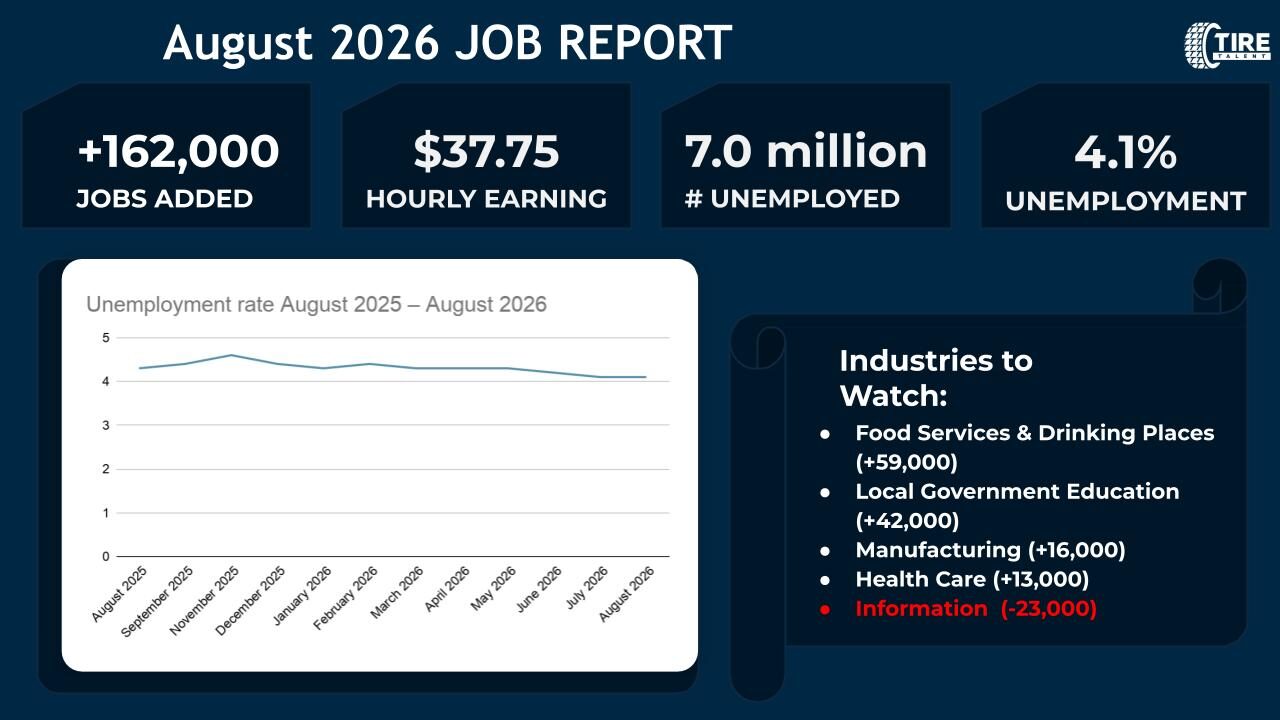
First, August itself came in strong: total nonfarm payroll employment rose by 162,000, more than five times the 31,000 average monthly gain over the prior twelve months. Second, and arguably more important, July was revised from -23,000 to +21,000. The negative print that generated so much concern did not survive the arrival of additional data. June was revised up as well, from +20,000 to +31,000. Combined, June and July are now 55,000 jobs higher than previously reported.
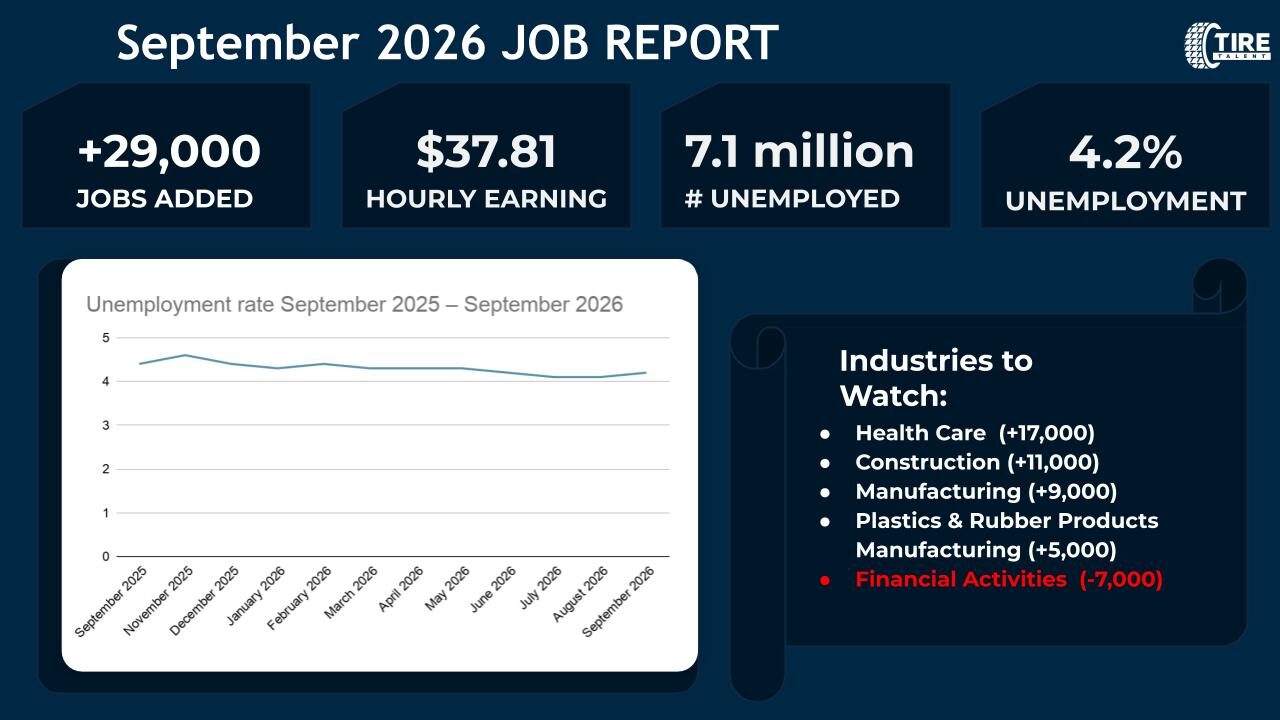
The unemployment rate held at 4.1 percent, unchanged, with 7.0 million people unemployed. Both figures have moved very little over the year.
Here is what the numbers say, and what they mean for the tire and automotive industry specifically.
The Numbers Behind the Headline
Food services and drinking places led the month with 59,000 jobs added, far above the sector’s 12,000 monthly average. Local government education added 42,000, largely reversing the July decline that had dragged the prior headline into negative territory. Construction added 22,000, with nonresidential specialty trade contractors continuing a steady upward trend. Health care added 13,000, slower than its recent pace but still positive.
The information sector was the clear loser, dropping 23,000 jobs across computing infrastructure and data processing, publishing, and broadcasting. That decline is consistent with a longer pattern in the sector and does not signal broader weakness.
Manufacturing is the story that matters most for this audience, and it is quietly encouraging. Manufacturing employment rose by 16,000 in August and is now up 58,000 since its recent low in December 2025. Two subsectors adjacent to the tire and automotive supply chain both continued trending up: machinery manufacturing added 6,000 and fabricated metal product manufacturing added 6,000.
The manufacturing workweek edged up to 40.5 hours. Overtime held at 3.1 hours. Read together with the headcount gains, this is a sector adding both people and hours, which is what expansion looks like in the early stages rather than a plant simply squeezing more out of its existing crew.
On wages, average hourly earnings for all private employees rose 10 cents to $37.75, up 3.1 percent over the year. For production and nonsupervisory employees, the category that includes tire technicians, plant operators, and service staff, earnings rose 11 cents to $32.53.
Two household survey figures deserve attention. The labor force participation rate edged up to 61.6 percent, though it remains 0.5 percentage points below January. And the number of people working part time for economic reasons fell by 414,000 to 4.4 million. That is a substantial drop in the number of people who wanted full-time work but could not find it, and it points to employers converting hours rather than cutting them.
What This Means for Tire Industry Employers
The August report changes the recruiting calculus from last month, and not in the direction most employers were bracing for.
A month ago, the negative July print suggested the candidate pool might begin to loosen. Some tire employers held searches on the assumption that conditions would soften and hiring would get easier. The August data, and especially the July revision, removes that assumption. The labor market did not contract. It paused, then resumed, and manufacturing specifically has now added jobs for most of the year.
For tire plants and manufacturing operations, the practical implication is that the competition for skilled production and technical talent is not easing. Machinery and fabricated metal manufacturers, who draw from the same regional pools of maintenance technicians, process engineers, and skilled operators, are actively hiring. Every one of those hires is a candidate who is no longer available to a tire plant in the same market.
For tire dealers and commercial service operations, the food services surge is worth noticing for a specific reason. That sector competes directly with retail tire shops for entry-level hourly workers, and it just added 59,000 jobs in a month. Shops that have been struggling to staff tire technician and lube technician roles at the entry level are competing against restaurants that are hiring aggressively and often offering more schedule flexibility.
The 414,000 decline in involuntary part-time work is a related signal. People who were working reduced hours and looking for more are getting more. That shrinks the pool of underemployed workers who might have been available for additional shifts or a full-time move.
The employers who will hire well through the fall are the ones treating this as a tight market, because it is one. That means market-rate offers made quickly, active outreach to candidates who are not applying, and a hiring process that does not lose a qualified technician to a three-week decision cycle.
What This Means for Tire Industry Job Seekers
If you are a tire technician, service advisor, plant operator, or engineer, the August report is good news with a clear implication.
Wage growth of 3.1 percent year over year is holding. Manufacturing is adding jobs. The subsectors closest to tire and automotive are trending up. The employers you might work for are competing for people with your background, and the July scare that briefly suggested otherwise turned out to be a data artifact.
The specific opportunity is at the offer stage. In a market where employers expected softening and got the opposite, there is a gap between what many companies budgeted for hiring and what it will actually take to close a qualified candidate. That gap is negotiating room. Candidates with commercial or OTR tire experience, plant maintenance backgrounds, or process engineering credentials are in a position to ask for what the market is paying rather than what a job posting listed.
For anyone who has been considering a move but waiting for a clearer signal, the August report is about as clear as monthly data gets.
The Revision Lesson
One point worth carrying forward from this cycle: the July headline was wrong, and it was wrong in a direction that mattered.
A -23,000 print became a +21,000 print with one additional month of data. That is a 44,000-job swing on a number that was widely treated as definitive when it was released. The June figure moved by 11,000 in the same direction.
Monthly payroll numbers are estimates that get better with time. The first print is the least reliable version. Employers and job seekers who make decisions on the initial release, especially decisions to freeze searches or delay moves, are reacting to data that will change. The three-month trend is a better guide than any single month, and the three-month trend in manufacturing has been positive since the start of the year.
The Bottom Line
August delivered 162,000 jobs, an unchanged 4.1 percent unemployment rate, 3.1 percent wage growth, and a manufacturing sector that has now added 58,000 jobs since December. The July contraction that dominated last month’s conversation has been revised away.
For the tire and automotive industry, the message is consistent with what the structural picture has shown all year. The market for skilled technicians, plant talent, and engineering professionals remains tight, the employers who move with intention continue to hire well, and the candidates with genuine industry experience continue to have options.
Tire industry employers with open roles: Connect with the Tire Talent recruiting team to discuss what the current candidate market looks like and how to close qualified candidates before the competition does.
Tire industry professionals exploring what the market offers: Browse current opportunities at Tire Talent or reach out directly to explore what your experience is worth right now.