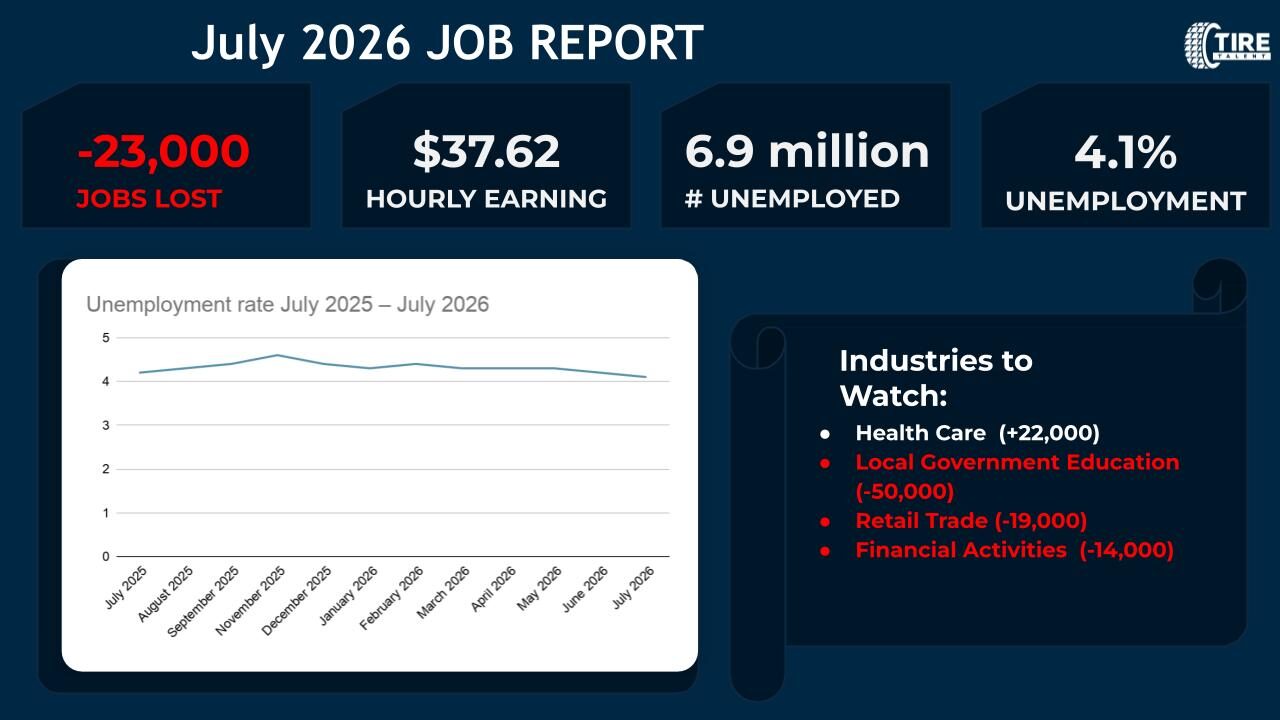
The Bureau of Labor Statistics released the July 2026 employment situation report this week, and the headline is the kind that stops a scroll: the U.S. economy shed 23,000 jobs last month. Total nonfarm payroll employment went negative for the first time in this cycle, and the unemployment rate held at 4.1%.
Before the alarm bells get too loud, context matters. The July number is heavily shaped by a 50,000-job decline in local government education — a seasonal pattern tied to school calendars that can swing the headline dramatically. Strip that out and the picture is still soft, but it’s not the economic collapse the top-line suggests. What it is, however, is confirmation of a trend that has been building for months: the labor market is decelerating, the revisions keep coming in negative, and the floor is lower than most employers and job seekers had assumed.
The Numbers Behind the Number
Beyond local government education, retail trade lost 19,000 jobs in July. Warehouse clubs, supercenters, and general merchandise retailers accounted for the bulk of that (-21,000), with gas stations and fuel dealers down another 5,000. Financial activities continued a longer slide, dropping 14,000 in July and now sitting 121,000 below its May 2025 peak. Health care was the lone bright spot, adding 22,000 jobs — though even that was slower than its recent monthly average of 36,000.
Manufacturing showed little change in July. The average manufacturing workweek held at 40.4 hours, and overtime edged down slightly to 3.1 hours. That combination — stable hours, modestly retreating overtime — suggests manufacturers are managing output without adding headcount, and without cutting it either. For tire manufacturing facilities, this reads as a cautious hold: production is running, but expansion isn’t on the table.
The revisions deserve their own sentence. May’s job gains were revised down by 66,000 — from +129,000 to +63,000. June was revised down 37,000 — from +57,000 to +20,000. Combined, May and June are now 103,000 jobs lighter than what was reported. The monthly numbers have been consistently overstated and quietly corrected downward. The 12-month average gain is now just 34,000 jobs per month.
On wages: average hourly earnings for all private-sector employees came in at $37.62, up 3.2% over the year. For production and nonsupervisory employees — the group that includes tire technicians, service advisors, and production workers — hourly earnings hit $32.40. The labor force participation rate held at 61.4%, down 0.7 percentage points since January.
One number worth watching: temporary layoffs jumped by 153,000 to 921,000 in July. Temporary layoffs are a leading indicator — they can convert to permanent separations quickly if conditions don’t improve, or reverse just as fast if demand rebounds. At 921,000, that pool is worth monitoring over the next two months.
What This Means for Tire Industry Employers
A negative payroll print and a softening labor market create a different recruiting environment than the one most tire employers have been operating in for the past two years. The candidate pool that felt impossibly tight is beginning to loosen — not dramatically, not uniformly, but at the margins.
For general production and service roles, this is actually a moment to move. Workers who were difficult to reach when the overall market was strong are more willing to have a conversation when the headlines feel uncertain. If you have been putting off a search because you didn’t think you could close anyone, that calculus is shifting.
The caveat, as always in the tire industry, is that roles requiring specific experience — tire technicians with commercial or OTR experience, process engineers with tire manufacturing backgrounds, sales professionals with fleet account relationships — are not materially easier to fill just because the macro number went negative. The specialized talent pool doesn’t expand when the BLS releases a soft report. Outbound recruiting is still the right approach for those searches.
The retail trade decline is worth a specific note for tire dealers and service chains. A consumer spending environment that is pulling back — reflected in the warehouse club and general merchandise declines — does affect foot traffic patterns at tire retail locations. If customer volume softens heading into Q4, workforce planning decisions made now will matter. Overstaffing into a slowdown is expensive; understaffing into a rebound is worse.
What This Means for Tire Industry Job Seekers
If you are a tire technician, service advisor, commercial account manager, or operations professional reading these headlines with some anxiety — the July report is not the signal you need to panic.
Wage growth of 3.2% year-over-year is real and consistent. The tire industry continues to operate in a structural shortage of experienced technicians and specialists that a soft macro report does not fix. Tire services — passenger vehicle maintenance, commercial fleet work, OTR — are not discretionary in the way that restaurant meals or retail purchases are. Tires wear out regardless of what the BLS says on the first Friday of the month.
What the softening market does change is the negotiating dynamic at the offer stage. Employers who have been slow to move on compensation decisions may be more flexible now than they were six months ago. If you have been thinking about exploring what the market currently offers for your experience level, a moment when employers are competing harder for qualified candidates is not a bad time to find out.
The Bottom Line
July’s -23,000 headline is eye-catching, but the more important story is in the cumulative picture: a 12-month average of 34,000 monthly jobs, 103,000 in downward revisions across May and June, and a labor force participation rate that has been drifting lower all year. The labor market isn’t collapsing — but the strength that defined 2023 and 2024 is clearly gone.
For the tire and automotive industry, the practical implications are real but manageable. Employers who move with intention — on compensation, on candidate engagement, on process speed — will continue to hire well. Job seekers with genuine experience in the tire sector remain in a market that needs them. The monthly report is one data point. The structural reality of the tire industry’s talent market is a longer story, and it hasn’t changed because of one month’s payroll number.
Tire industry employers with open roles: Connect with the Tire Talent recruiting team to discuss what the current candidate market looks like and how to move faster than the competition.
Tire industry professionals exploring their options: Browse current opportunities at Tire Talent or reach out directly to explore what the market offers for your background.