
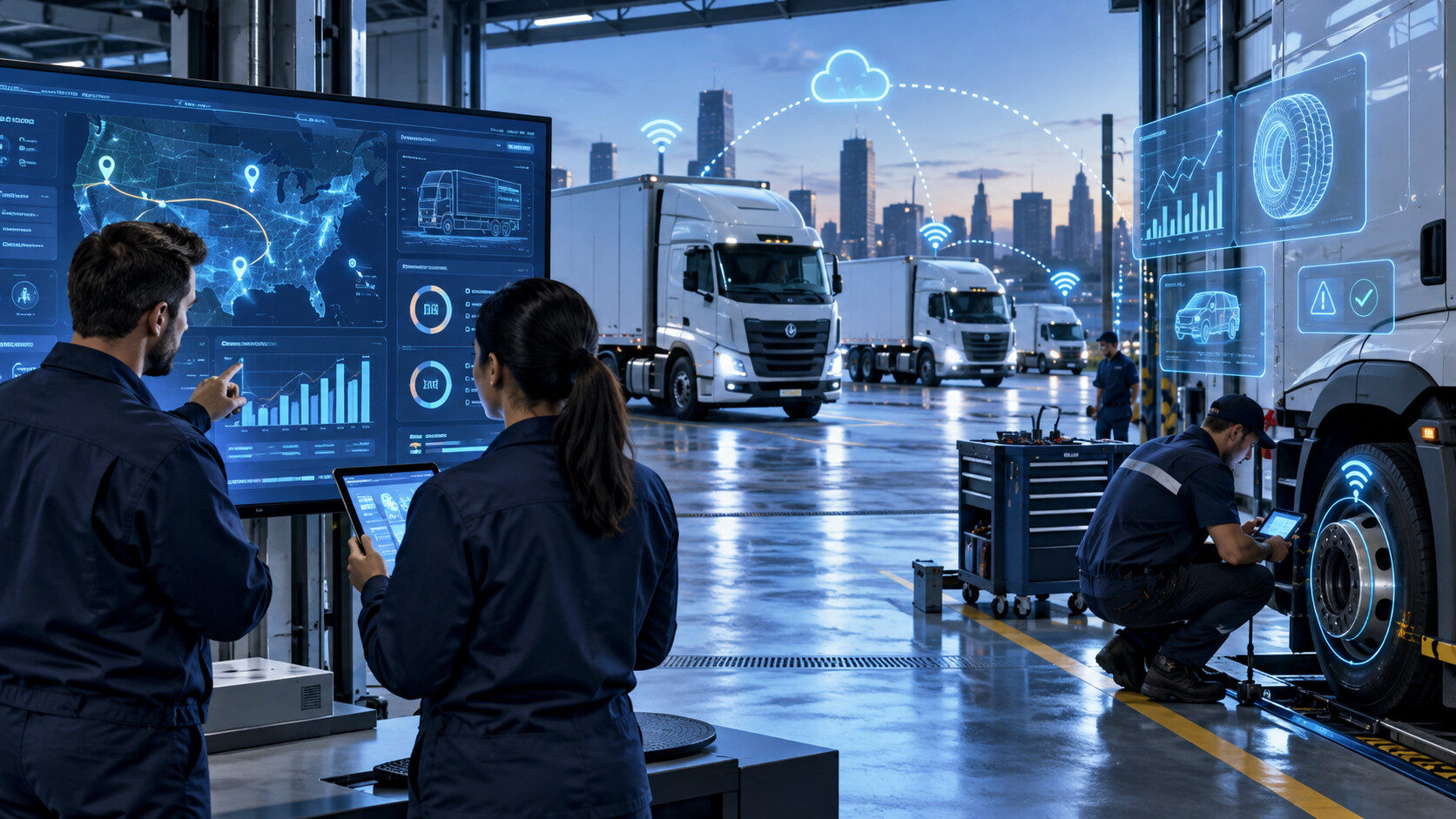
Smart tire technology is changing what happens in a commercial tire bay faster than most tire employers have planned for. For decades, the tire was the least connected part of a truck. The engine reported fault codes, the ELD logged hours, and the telematics unit tracked every mile, while the tires were checked by someone walking the yard with a pressure gauge and a tread depth tool.
That is ending. In March 2026, Michelin launched its Smart Predictive Tire for trailers hauled by Class 7 and 8 fleets, using real-time pressure and temperature data and a leak-detection algorithm to flag trouble before it turns into a roadside failure. Continental has developed ultrasonic sensors that measure tread depth continuously. Goodyear has said it wants tire intelligence built into all of its new products by 2027. Analysts put the automotive smart tire market at $5.3 billion in 2026, growing to $8.6 billion by 2033, with connected tires the fastest-growing segment.
Most of the coverage is about the hardware. Far less of it is about the people who have to install it, maintain it, make sense of what it reports, and sell it to fleets. That is a workforce question, and it is landing on an industry that is already short of people. In 2025 research from the American Transportation Research Institute, 65.5% of fleet maintenance shops reported being understaffed, with nearly one in five technician positions sitting empty.
Here is what connected tires change about the work, which skills are becoming scarce, and how tire employers can hire and train for them.
What Smart Tire Technology Actually Does
A connected tire system has three parts. Sensors sit inside the tire, on the valve stem, or in the valve cap and measure pressure and temperature; newer designs add tread depth and load. A gateway on the vehicle collects those readings and sends them to the cloud. Software then looks for patterns and pushes alerts to the fleet manager, the driver, or the tire dealer servicing the account.
Bridgestone’s IntelliTire, for example, combines stem-mounted flow-through sensors with internal sensors and sends the data to a cloud platform that issues alerts and reports. Michelin’s system uses an algorithm it calls Smart Leak to catch slow pressure loss early. Goodyear’s SightLine works on similar principles and is also feeding tire data into autonomous trucking systems.
The economics are what is driving adoption. Industry estimates put sensors at roughly $25 to $50 per tire, which means $450 to $900 for an 18-wheel tractor-trailer before the gateway and installation. Total cost per vehicle usually lands between $650 and $1,500, and fleets commonly report payback within a year. Fuel is part of the return: an FMCSA study found tire pressure monitoring improved fleet fuel economy by about 1.4%. On a truck burning 20,000 gallons of diesel a year, that works out to roughly 280 gallons saved.
The bigger return is timing. Predictive systems are designed to identify tires that need attention well before they fail, in some cases 30 to 60 days out. A problem that would have been an emergency road call becomes a scheduled stop.
How Smart Tire Technology Changes the Work
Connected tires do not take work out of the tire business. They move it around and change what it looks like. Three shifts matter most for employers.
Reactive work becomes scheduled work. A commercial tire operation built around road service starts to run more like a planned maintenance program. Fewer technicians get sent to a highway shoulder at 2 AM. More of the work happens in the fleet yard, on a schedule, driven by alerts that came in days earlier.
Every tire becomes a data record. In a connected program, each tire has a position, a serial number, a pressure history, and a wear trend. That record is only accurate if the people who handle the tire keep it accurate. When a technician swaps a tire and doesn’t update its position in the system, the data for that vehicle is wrong until somebody notices.
Fleets start buying outcomes instead of tires. A fleet manager looking at a dashboard of cost per mile, road call frequency, and tire life stops comparing quotes on unit price alone. The question becomes which dealer delivers more uptime for less money.
Tire manufacturers are heading the same direction. Bridgestone and Michelin have been the most active buyers of fleet management solution providers, and the major tire makers now present themselves as service and data companies as much as product companies. When the business model changes, the skills the business needs change with it.
The New Skills, Role by Role
Commercial Tire Technicians
The commercial tire technician is the person who makes a connected tire program work or fall apart, and the job is getting broader.
Sensor installation, pairing, and gateway setup are becoming routine. So is troubleshooting. When an alert fires, the technician has to work out whether the problem is the tire, the sensor, or the connection. A dead sensor battery and a slow leak can look alike on a dashboard, and a technician who can tell them apart saves a truck from an unnecessary stop. Too many false alerts and drivers start ignoring the system, which defeats the point of having one.
Record-keeping is the least glamorous skill on the list and one of the most important. A connected tire program is only as good as the last entry a technician made. Tire position, serial number, tread depth, and the work performed all need to go into the system correctly, every time.
Technicians also need to be comfortable working from tablets and apps, because more work orders will come from the platform than from a phone call.
What doesn’t change is the foundation. Safe mounting and demounting, inflation cage procedures, torque, and sound judgment about a casing matter as much as they ever did. Digital skill sits on top of those fundamentals. It doesn’t replace them.
Fleet Tire Managers and Tire Program Managers
On the fleet side, and at dealers that run tire programs for fleet customers, the tire manager’s job is turning into a data job.
The work now includes reading trends across hundreds of vehicles and spotting patterns: a trailer pool that runs hot, a route that wears out steer tires early, a yard where pressure checks keep getting skipped. It includes setting alert thresholds so the system flags real problems without burying the team in noise. And it includes tracking KPIs like cost per mile, removal tread depth, road call frequency, and casing retread rates.
There is vendor management too. Tire data usually has to flow into a fleet’s wider telematics platform, and getting those systems to work together takes patience and some technical comfort. Job postings for fleet tire managers currently range from about $53,000 to $117,000 (ZipRecruiter, August 2026), and the top of that range goes to people who can do the analysis, not just the scheduling.
Commercial Tire Sales Reps and Fleet Account Managers
For sales roles, connected tires change the conversation with the customer.
A rep who sells on price per tire is competing with a web portal. A rep who can pull up the customer’s own data in a quarterly review, explain why one lane keeps losing trailer tires early, and show what fixing it would save is much harder to replace. The job becomes more consultative: selling uptime and cost per mile, and making the case with numbers the customer already trusts.
Reps also need a working understanding of how tire data connects to the fleet’s other systems. In July 2026, Michelin Connected Fleet partnered with Platform Science to offer Smart Predictive Tire through Platform Science’s Virtual Vehicle marketplace. That kind of integration is quickly becoming normal, and fleet customers will expect their tire rep to understand it.
Roles That Barely Existed Five Years Ago
A handful of roles are appearing that sit between tire knowledge and software:
- Connected fleet specialists at dealers, who own sensor installs, platform setup, and alert triage for fleet accounts
- Tire data analysts, who turn sensor readings into recommendations a fleet can act on
- Customer success roles at tire manufacturers’ digital businesses, supporting fleets that run on their platforms
Very few people have both halves of that skill set yet, which is exactly why these roles are hard to fill.
Where to Find People With These Skills
The core hiring problem is simple: hands-on tire experience combined with digital fluency does not exist at scale yet. A job description asking for “three or more years of connected tire experience” will produce a very short list, and most of the people on it already have jobs.
Employers who staff these roles well tend to draw from three pools.
Your own technicians. This is the best source. Look for the technician who already likes TPMS work, gravitates toward diagnostic problems, and keeps clean records without being reminded. They already know tires. Teaching them the platform is the easier half.
Adjacent trades. Telematics and ELD installers, diesel technicians used to diagnostic software, and automotive technicians with TPMS and ADAS calibration experience all bring the digital half. Teach them tires.
Fleet software and telematics companies. For account, analyst, and program manager roles, people from customer success or implementation teams at fleet technology companies already speak the language of fleet KPIs. The tire knowledge can be built.
In interviews, test for the skills that actually matter. Ask a technician to walk you through an alert or diagnostic reading that turned out to be something other than what it first looked like. Ask how they keep their records straight when the shop is slammed. Ask a sales or account candidate to explain a set of fleet data to you as if you were a fleet manager with ten minutes to spare. The answers will tell you more than the résumé.
Upskill Before You Hire
For most tire employers, training the people already on staff will be faster and cheaper than finding new ones.
Starting from scratch is expensive. ATRI found that 61.8% of technicians begin their careers without formal training, and getting a new technician up to speed takes an average of 357 hours of instruction and more than $8,000 in trainee wages. Adding sensor and platform skills to a proven technician costs a fraction of that.
A few practices work well.
Use manufacturer and vendor training. Tire makers and sensor suppliers generally offer product training on their systems. Put it on the schedule as part of the job, not something technicians squeeze in when the bays are quiet.
Pair veterans with newer technicians. Your most experienced people know what a tire looks like before it fails, how casings behave, and where the safety risks are. Newer technicians are often quicker with the apps. Pairing them lets each teach the other, and it keeps veteran knowledge in the building longer.
Pay for the skill. Create a connected fleet specialist tier with a real pay step. If new skills don’t come with more money, the people who learn them fastest will take them to an employer who pays for them.
What This Means for Tire Employers
Connected tire technology is also a recruiting and retention opportunity, and it gets less attention than it should.
The hardest part of commercial tire work has always been the emergency road call: nights, weekends, bad weather, and a highway shoulder with traffic flying past. Every road call that turns into a scheduled stop makes the job more livable. Employers running connected programs can offer something a lot of competitors can’t, which is steadier hours and fewer 2 AM callouts. That is a genuine selling point for a candidate weighing commercial work against a retail shop.
There is a competitive risk on the other side. Fleets will increasingly pick tire partners who can support a connected program from installation through data review. Dealers without the people to do that work will lose accounts to dealers who have them. Building that capability takes a year or more, which is a good reason to start now.
What This Means for Tire Professionals
If you are a commercial tire technician, learning sensors, diagnostics, and the major fleet platforms is one of the fastest ways to stand out right now. The group of technicians who can handle both the physical work and the digital work is small, and employers are starting to notice who is in it.
If you work in sales or account management, learn to read and present fleet data. Being able to tell a fleet customer what their own numbers mean is becoming the difference between a trusted advisor and a price quote.
If you are earlier in your career, our guide on how to become a tire technician in 2026 covers the main entry paths, and connected tire skills are a smart thing to build toward from the start.
Frequently Asked Questions
What is a smart tire?
A smart tire is a tire fitted with sensors that measure conditions such as pressure, temperature, tread depth, or load. The readings go to a gateway on the vehicle and then to a cloud platform, where software analyzes them and alerts fleet managers or tire dealers to problems like slow leaks, underinflation, or overheating, often before they cause a failure. Michelin, Bridgestone, Goodyear, and Continental all offer connected tire systems for fleets.
Will smart tire technology replace tire technicians?
No. Connected tires change when and how tire work happens, but they don’t remove the need for it. A sensor can flag a problem, but someone still has to find it, fix it, replace the tire, and keep the system accurate. The technology tends to shift work from emergency road calls to scheduled service and adds new tasks such as sensor installation and alert troubleshooting. Technicians with both hands-on and digital skills are likely to be in more demand, not less.
What skills do commercial tire technicians need for connected fleets?
On top of core commercial tire skills, technicians increasingly need to install and pair tire sensors, set up and troubleshoot vehicle gateways, tell a real tire problem apart from a sensor or signal fault, and record tire data accurately in the fleet’s platform. Comfort working from tablets and apps is becoming standard as well. The fundamentals of safe mounting, inflation, torque, and casing inspection are as important as ever.
How much do tire sensors cost for a fleet?
Industry estimates put tire sensors at roughly $25 to $50 each. For an 18-wheel tractor-trailer, that comes to about $450 to $900 in sensors, plus $100 to $300 for a gateway and the cost of installation, for a total of roughly $650 to $1,500 per vehicle. Fleets commonly report payback within 12 months through fuel savings, longer tire life, and fewer road calls.
The Bottom Line
The tire is becoming a data device, and that changes the tire business from the service bay to the sales call. Technicians need to install, troubleshoot, and keep the data clean. Tire managers need to turn readings into decisions. Sales reps need to sell uptime using the customer’s own numbers.
None of those skills are common yet, and the industry is already short of technicians. The employers who come out ahead won’t be the ones waiting for experienced connected-fleet candidates to show up. They’ll be the ones who start training their best people now, pay for the new skills, and use the shift toward scheduled work as a reason for good people to stay.
For tire dealers, fleets, and manufacturers building connected-fleet capability: connect with the Tire Talent team to find commercial technicians, fleet tire managers, and account managers with the skills this shift requires.
For tire professionals ready to put new skills to work: browse current opportunities at Tire Talent or reach out confidentially to see what the market is paying for your experience.