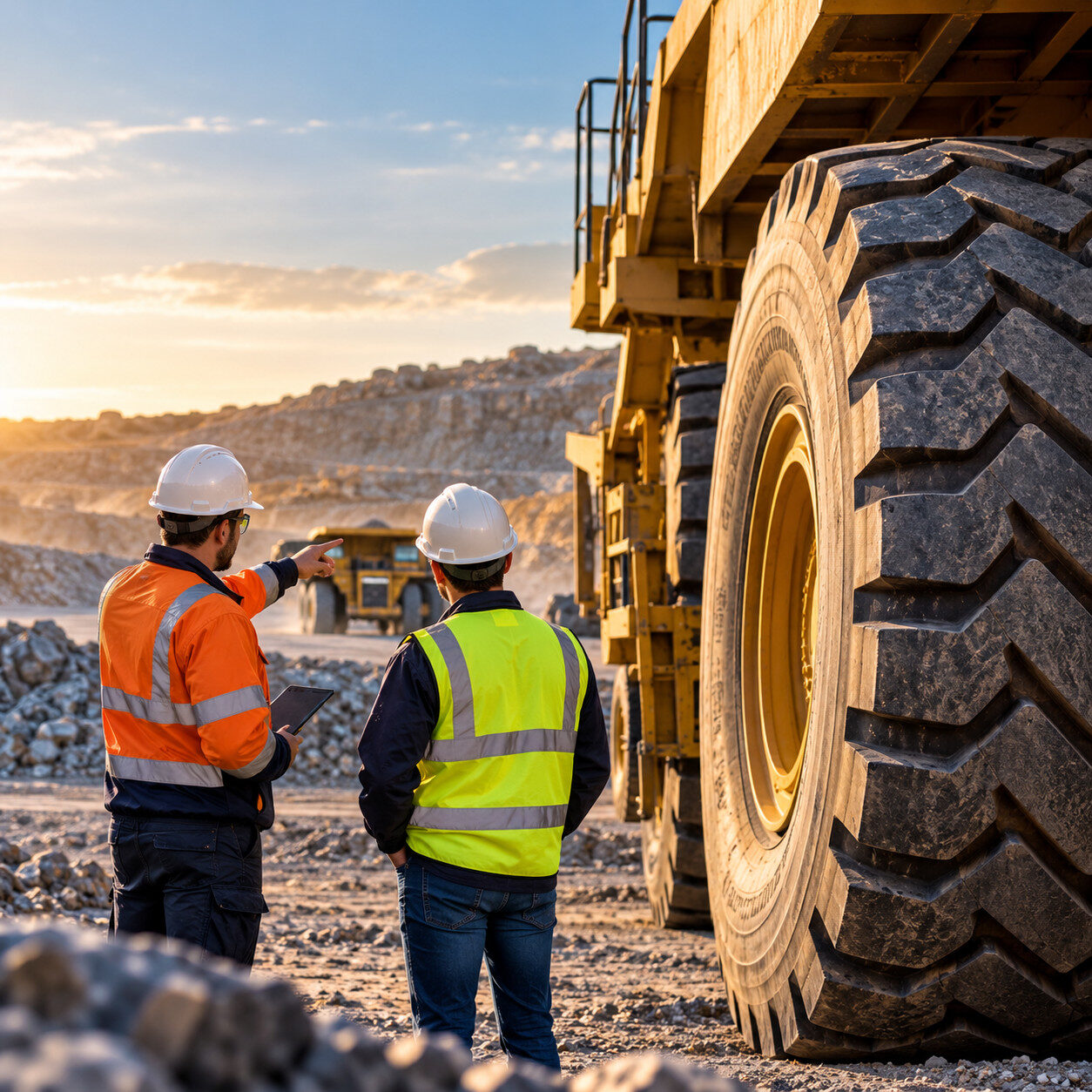
OTR tire sales operates at a scale that is difficult to appreciate from inside the rest of the tire industry.
A single Ultra Class mining tire — the 40.00R57 through 63/80R63 sizes fitted to ultra-class haul trucks like the Caterpillar 797 or Komatsu 930E — runs between $60,000 and $100,000 or more. A 40.00R57 alone can exceed $30,000. A haul truck carries six of them. A surface mine running forty haul trucks is managing a tire budget that looks less like a consumable line item and more like a capital program.
That scale changes the job completely. And it produces the one genuine anomaly in tire industry sales careers: this is the track you generally cannot enter from retail, no matter how well you sell.
Our tire sales representative career path guide covers the standard progression from retail through wholesale into commercial and fleet. This is about the specialization that sits at the top of that structure, how it actually works, and why the entry route runs through technical credibility rather than selling ability.
Why OTR and Mining Sales Is a Different Job
Four things separate it from commercial fleet sales, which is itself the most demanding of the conventional tracks.
The ticket size removes price from the conversation. When a tire costs $60,000, nobody is making a purchase decision on the quote. They are making it on expected service hours, failure risk, and the cost of unplanned downtime on a haul truck that moves several hundred tons a shift. A rep who leads with price has misread the room entirely.
The buyer is technical. You are presenting to maintenance planners, reliability engineers, and site managers who understand tire performance data better than most tire salespeople do. They have run the numbers. They will check yours.
The deliverable is usually a program, not a product. Mining accounts typically buy tire management: site surveys, tire tracking and position history, selection against site conditions, scrap analysis, rotation strategy, and in many cases on-site service personnel. The tires are part of what is being sold, not the whole of it.
The work happens on site. Pit walls, haul roads, active mining operations. Safety inductions, PPE, mine-site awareness requirements, and travel to locations that are remote by design. This is not a job conducted over video calls.
TKPH: The Technical Bar You Have to Clear
If there is a single gate on entry to this field, it is TKPH.
TKPH stands for Ton-Kilometer Per Hour, and it expresses the thermal load a tire can safely sustain given the combination of payload, speed, and haul cycle length. Heat is what destroys large OTR tires. TKPH is how the industry quantifies whether a given tire can survive a given site’s duty cycle.
The real-site calculation runs:
TKPH = ((loaded weight per tire in tonnes × loaded distance in km) + (empty weight per tire in tonnes × empty distance in km)) ÷ total cycle time in hours
Every tire carries a rated TKPH. If the site’s calculated TKPH exceeds the tire’s rating, the tire will run hot and fail early — sometimes catastrophically, which on a mining haul truck is a serious safety event, not just a cost event.
What this means practically for a sales career: you have to be able to sit with a mine’s maintenance planner, work through their haul profile, calculate site TKPH, and explain which tire fits and which does not — including telling them your own product is wrong for their application when it is. A rep who cannot do this is not having a technical conversation. They are waiting outside it.
This is the reason retail and even commercial fleet selling experience does not transfer cleanly. The skill being tested is applied engineering judgment, and it takes real time on site to build.
You’re Selling Cost Per Operating Hour
The commercial metric in this field is not price. It is cost per operating hour: tire cost divided by total service hours delivered.
That single reframe is the core of the sale. A premium tire at a materially higher purchase price can win decisively on cost per hour if it delivers more hours and fewer failures. A cheaper tire that fails early, or that forces a truck out of service unexpectedly, loses on every measure that matters to a mine.
The gains available from doing this well are substantial. Documented OTR tire management programs report reducing tire cost per operating hour by over 20% while extending tire life by roughly a quarter — and in one reported case, cutting catastrophic failures from around 52 per year to 7.
That last figure is the one that sells. Fifty-two catastrophic failures a year is a safety exposure and a production problem. Seven is a managed operation. A rep who can credibly connect their program to that kind of change is not negotiating on unit price.
It also explains why these relationships are durable. A mine that has cut cost per hour 20% with a supplier that understands its haul roads does not re-tender on price. Which is exactly why these accounts are hard to win and, once won, hard to lose.
What You’re Selling Alongside the Tire
Two things come bundled into an OTR sale that have no equivalent in most tire selling, and both sit largely outside the rep’s direct control. Understanding them is part of the job.
Service capability. A giant tire is useless to a mine without someone able to change it on site. That means field service trucks, boom cranes and manipulators, trained OTR technicians, and the ability to respond when a truck goes down at 3 AM on a Sunday. When a mine evaluates a supplier, they are evaluating that service organization at least as much as the tire. A rep whose service operation is thin will lose accounts regardless of product quality — and a rep with a strong one can win on it. Practically, this means a significant part of the job is working internally: making sure service coverage exists, techs are trained, and commitments made in a meeting can actually be honored.
Supply and allocation. Global capacity for the largest OTR sizes is limited and concentrated among relatively few manufacturers. Demand swings with commodity cycles, and when mining activity runs hot, giant tire availability has historically tightened — sometimes severely. In those periods the question stops being price and becomes whether a customer can get tires at all, and allocation decisions get made on relationship and account history.
That dynamic cuts both ways for a sales career. It means the value of a trusted supplier relationship is far higher than in a commodity market, and it means that during tight periods a rep spends real time managing expectations about availability rather than selling. People who handle those conversations honestly tend to keep accounts through the cycle. People who over-promise during a shortage lose them permanently.
What It Pays
Our tire industry salary guide and the sales career path guide set out the broader bands: territory representatives with two to five years at $70,000 to $95,000 base and $90,000 to $140,000 on-target earnings, senior and national account representatives at $90,000 to $125,000 base with total compensation of $130,000 to $200,000 or more, and regional sales managers reaching $140,000 to $200,000-plus in total compensation.
OTR and mining sales sits at the premium end of those bands, and the reasons are structural rather than generous. The technical barrier to entry limits the candidate pool severely. Account values are enormous, so incentive plans on a percentage basis produce large numbers. The travel and site conditions carry a genuine premium. And experienced OTR people are known quantities within a small industry, which gives them leverage.
For context on where the ceiling sits, national account management roles across industries average around $142,000 with top-decile earners above $230,000, and the strongest performers in tire sales at major distributors and OEM accounts are among the highest-compensated individual contributors anywhere in the industry.
The honest framing: OTR and mining is not reliably the highest-paying tire sales job in year one. It is the one with the highest ceiling and the most defensible position once you are established, because very few people can do it.
How People Actually Get In
This is the part that differs most from the conventional career advice, and it is worth being direct about.
The common entry routes are not sales routes.
From the service side. The most reliable path is through OTR service — working as an OTR tire technician or service manager on mine and quarry sites, building genuine knowledge of how these tires fail and why, then moving into a commercial role. Technicians who have changed giant tires on a pit floor and diagnosed failures in service carry credibility a career salesperson cannot manufacture.
From mining and heavy equipment. People who have sold or supported earthmoving equipment, mining consumables, or heavy equipment service already know the customer, the site environment, and the procurement process. The tire knowledge is the gap, and it is the easier gap to close.
From within a manufacturer or major dealer. Internal moves from OTR product management, applications engineering, or inside sales into field roles are common, because the technical foundation is already there.
Rarely from retail or passenger sales. Not because retail people lack ability, but because nothing in that work builds TKPH literacy, site experience, or credibility with a maintenance planner. Someone making this jump usually has to route through service or a technical role first.
If you are early in a tire career and want this track, the practical advice is to get onto OTR service work. It is physically demanding and the environments are difficult, but it is the apprenticeship for the highest-ceiling sales role in the industry.
The Ladder Above Territory
The progression from an established OTR territory role runs in a few directions.
Regional OTR manager, overseeing multiple territories and the service operations supporting them, with responsibility for program delivery across accounts.
National accounts, mining. Major mining groups buy centrally, and the roles that manage those relationships — titles like national account manager or mining tire sales manager — coordinate across supply chain, regional teams, and service organizations. The Maxam-style posting combining solid OTR and national accounts under one role is typical of how these are structured.
Manufacturer field and applications roles. Michelin, Bridgestone, Titan, BKT, and others need people who can support dealers and end users technically — product training, application engineering, field problem-solving. These suit people who want the technical depth without the quota.
Dealer leadership or ownership. OTR service businesses are real businesses, and people who understand both the service economics and the customer relationships are well placed to run or buy one.
What Makes Someone Good At It
A few traits separate the people who thrive from those who last eighteen months.
Comfort being on site, in a pit, in bad weather, in steel-toe boots, repeatedly. Numeracy, specifically the willingness to build and defend a cost-per-hour model in front of someone who will challenge it. Patience for sales cycles measured in quarters rather than weeks, and for account counts in the dozens rather than the hundreds. And a particular kind of integrity: telling a customer that your tire is the wrong choice for their haul profile, because the alternative is a failure that ends the relationship permanently.
The people who struggle are usually strong transactional sellers who find the technical depth tedious and the pace slow.
Should You Want This Job?
Worth weighing honestly.
What you give up is geographic convenience and variety of activity. The travel is real, the sites are remote, and you will spend time in environments most sales professionals never see. Account counts are small, which means a single lost account is a serious year.
What you gain is a position very few people can fill, compensation at the top of the industry’s range, relationships that are genuinely consultative, and work with equipment and operations at a scale that most people find compelling rather than tolerable.
For the right person it is one of the best careers in the tire industry. For the wrong one it is a lot of travel to look at rocks.
Frequently Asked Questions
What does an OTR or mining tire sales representative do?
They sell and manage tire programs for surface mining, quarrying, construction, and earthmoving operations. The work involves calculating site TKPH against tire ratings, conducting site surveys, building cost-per-operating-hour cases, managing tire tracking and scrap analysis programs, and coordinating service delivery — usually across a small number of very large accounts rather than a broad territory of small ones.
How much do OTR and mining tire sales reps earn?
They sit at the premium end of tire sales compensation. Territory-level roles broadly align with the $90,000 to $140,000 on-target range for experienced reps, while senior and national account positions reach $130,000 to $200,000 or more, and the strongest performers at major distributors and OEM accounts exceed that. The premium reflects the technical barrier to entry, account values, and travel demands rather than a different commission philosophy.
What is TKPH and why does it matter in tire sales?
TKPH, or Ton-Kilometer Per Hour, measures the thermal load a tire can safely withstand based on payload, speed, and haul cycle length. It is calculated from loaded and empty weights per tire, the distances travelled in each state, and total cycle time. Every large OTR tire carries a TKPH rating, and exceeding it causes tires to run hot and fail early. For a sales professional, the ability to calculate and discuss site TKPH credibly is effectively the entry requirement for the field.
Can you move into OTR tire sales from retail tire sales?
It is uncommon as a direct move. Retail and passenger sales experience does not build the TKPH literacy, site familiarity, or technical credibility that mining customers expect. The usual routes in are through OTR service work as a technician or service manager, from mining and heavy equipment sales, or internally from a manufacturer’s product or applications function. Someone committed to this path from retail generally needs to spend time on the service side first.
The Bottom Line
OTR and mining tire sales is the highest-ceiling sales track in the tire industry and the one least accessible through conventional sales progression.
The barrier is technical. When a single tire costs more than a car and a failure on a haul truck is a safety event, customers buy from people who can calculate what their site will do to a tire and say so honestly. That capability is built on site, over years, which is why the pool is small and why the people in it are difficult to replace.
For anyone willing to start on the service side and learn the engineering, it is one of the most durable and well-compensated careers available in this industry.
For OTR dealers, mining suppliers, and manufacturers hiring commercial and technical sales talent: connect with the Tire Talent team — OTR, farm and ag, and mining are core specialties, and the candidate pool for these roles is small enough that outbound search is usually the only route.
For OTR technicians, service managers, and commercial sales professionals considering the mining track: browse current opportunities at Tire Talent or reach out confidentially to discuss what your OTR experience is worth and what a move into sales would look like.