If you want to know how to become a tire technician in 2026, the honest answer is that the barrier is lower than most people expect — and the ceiling is higher than most people assume. You do not need a four-year degree. You do not need prior automotive experience to get your first role. And the path from an entry-level position to a six-figure management or commercial sales career is well-defined, faster than most white-collar tracks, and accessible to anyone willing to build their skills deliberately.
There are currently approximately 89,524 tire technicians employed across the United States, with the Bureau of Labor Statistics projecting 15,500 new openings annually through 2032 — driven by consistent demand from tire retail chains, commercial fleet operations, and OEM manufacturing facilities that cannot find enough qualified candidates to fill their bays. The industry is short-staffed. The people who enter now, invest in certification, and build toward commercial or management roles will have real negotiating leverage throughout their career.
This guide covers every step required to become a tire technician in 2026: the requirements, the training path, the certifications that move the needle on your earnings, the realistic salary at each career stage, and the long-term career options that make tire service a genuinely compelling professional path for the right person.
What Does a Tire Technician Actually Do?
Before mapping the entry path, it is worth being specific about what the role involves — because “tire technician” covers meaningfully different work depending on which segment of the industry you enter.
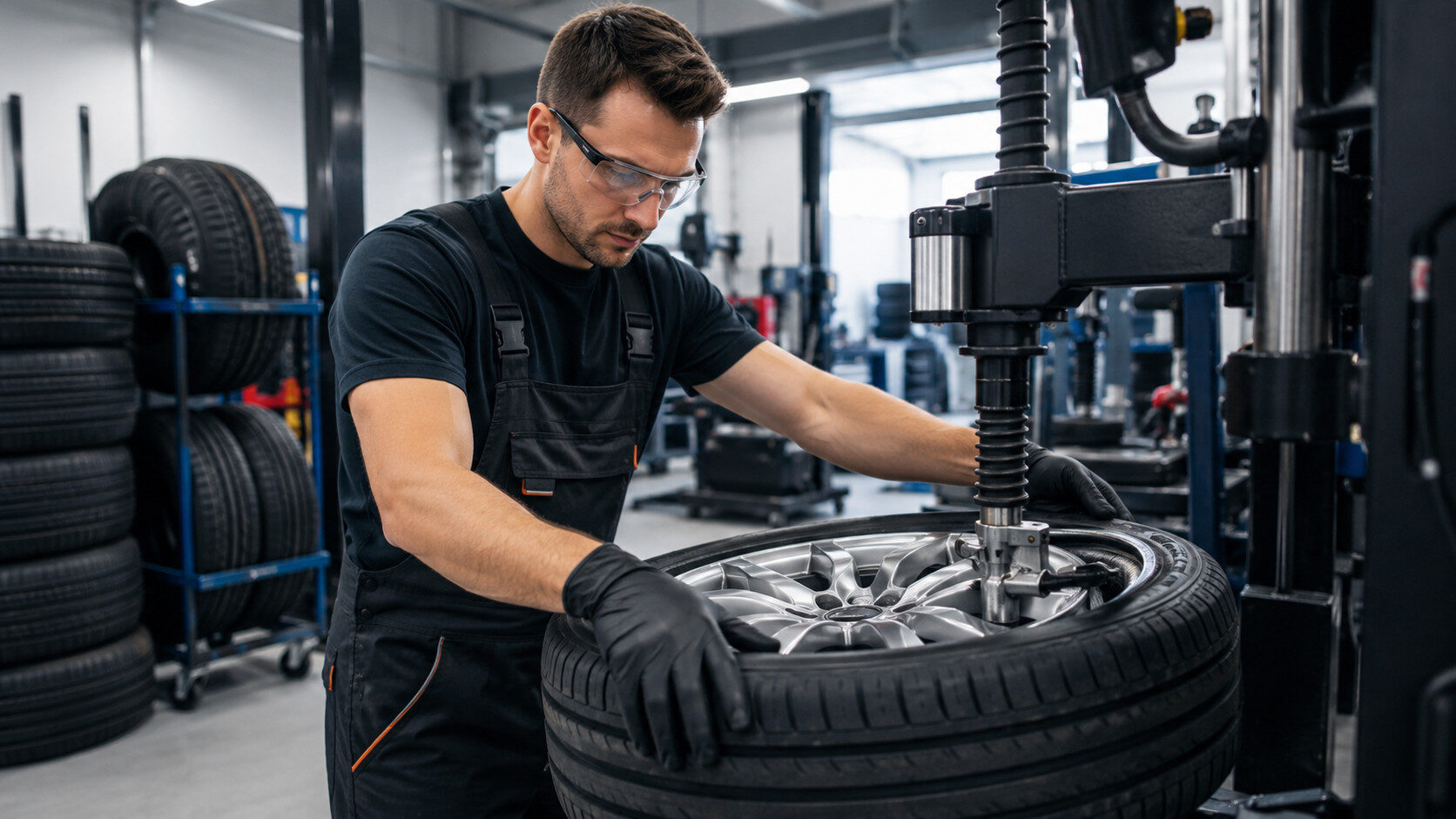
Retail tire technicians at dealerships and national chains (Discount Tire, Mavis, Monro, Firestone, Goodyear Auto Service) perform mounting, balancing, rotations, flat repairs, TPMS service, and increasingly, alignment checks and ADAS recalibration tied to EV and ADAS-equipped vehicles. Customer interaction is a daily part of the job. The pace is high, the bay volume is consistent, and the range of vehicle types is broad.
Commercial tire technicians service fleet vehicles — semi-trucks, buses, forklifts, agricultural equipment, and heavy construction machinery. Commercial work often involves roadside service, larger and heavier tire assemblies, and a premium on safety precision. The compensation is significantly higher than retail, the customer base is more stable, and the work is physically demanding in different ways.
OEM manufacturing tire technicians work in production facilities for Bridgestone, Michelin, Goodyear, Continental, and their Tier 1 suppliers — building tires rather than installing them. The entry track here is different but draws on overlapping mechanical aptitude and feeds into longer-term manufacturing career paths.
How to Become a Tire Technician: Step by Step
Step 1 — Meet the Basic Requirements
The minimum requirement to be hired as an entry-level tire technician at most retail and commercial operations is a high school diploma or GED. No automotive experience is required at the entry level at most national chains — they are specifically built to train from scratch.
What employers are looking for at this stage is mechanical aptitude (the ability to learn physical procedures quickly and follow precision steps), physical capability (tires are heavy; the job requires lifting, bending, and extended time on your feet), a valid driver’s license with a clean record, and the basic reliability and work ethic that allows on-the-job training to actually produce a productive technician.
Step 2 — Get Your First Entry-Level Role
The most direct path to becoming a tire technician is applying directly to tire retailers and commercial dealers in your area. The national chains — Discount Tire, Mavis Discount Tire, Monro Muffler Brake, Firestone Complete Auto Care, Goodyear Auto Service — hire entry-level technicians on a rolling basis. Independent dealers and regional chains hire similarly and often offer a more immediate path to senior tech responsibility.
When applying for your first role, prioritize operations that offer a defined training program and a written path to TIA certification. The dealers investing in technician development are the ones whose job postings mention specific certifications, training partnerships, or advancement timelines.
Step 3 — Complete On-the-Job Training
For most entry-level technicians, the first 90 to 180 days are a supervised training period — working alongside an experienced technician to learn tire mounting procedures, balancing equipment operation, flat repair techniques, rotation patterns, and TPMS service protocols. The learning curve is steep at first and then levels out quickly.
The technicians who advance fastest are the ones who ask questions, who volunteer for the more complex jobs, and who take the time to understand why a procedure is done a specific way — not just how to execute it. Tire service has a genuine technical dimension that rewards curiosity about the why behind the process.
Step 4 — Earn Your First Certification
The single most effective career investment available in the first year of a tire technician role is TIA certification. The Tire Industry Association’s Automotive Tire Service (ATS) program is the most recognized technical credential in the retail and commercial tire industry — and certified technicians consistently earn more than their uncertified peers at equivalent experience levels.
The difference between an uncertified first-year technician earning $14–$16 per hour and a TIA-certified technician with 12 months of experience earning $18–$21 per hour is real and immediate. The employers who offer certification cost reimbursement and a pay bump upon completion are telling you something important: they are serious about development, and they expect certification to increase your contribution enough to justify the investment.
Tire Technician Certifications That Matter in 2026
Certifications are the clearest signal to employers that a technician has invested in their own professional development — and in the tire industry, they directly translate to pay.
TIA Automotive Tire Service (ATS) — the foundational credential for retail tire service. Covers passenger and light truck tire and wheel assemblies. The minimum qualification threshold for senior technician consideration at most national chains. Study materials are available through TIA, and many employers cover the exam fee for technicians who commit to completing it.
TIA Commercial Tire Service (CTS) — covers commercial truck tire service and the specific safety requirements of larger tire systems. This certification is the gateway to commercial tire roles and unlocks a meaningful pay premium. Technicians who hold both ATS and CTS certification are genuinely rare and consistently in demand from commercial distributors and fleet service operations.
TIA Earthmover and OTR Tire Service — for technicians working with mining, construction, and agricultural equipment. The most specialized and best-compensated segment of the TIA certification track. Earthmover and OTR technicians with this certification regularly earn $80,000–$110,000+ annually.
ASE Certifications (A4 and A6) — the National Institute for Automotive Service Excellence offers certifications in Steering and Suspension (A4) and Electrical/Electronic Systems (A6) that are increasingly relevant as tire service expands into alignment and ADAS recalibration territory.
TPMS Certification — Tire Pressure Monitoring System service is now required on virtually every vehicle serviced. Certified TPMS technicians command higher pay and faster assignment to TPMS-specific work. This is the fastest-payback certification available in retail tire service — the training is short and the pay differential is immediate.
Tire Technician Salary: What You Can Realistically Earn
Understanding the salary progression at each stage of the career is one of the most important things a prospective technician can know — because the entry-level pay rates that show up in most search results do not reflect what the path actually looks like beyond year two.
Entry level (year 0–1, uncertified): $14–$18 per hour ($29,000–$37,000 annually). This is the floor, and it is not where anyone stays who pursues certification and advancement.
Certified technician (year 1–3, TIA ATS): $18–$23 per hour ($37,000–$48,000 annually). The pay jump from earning TIA certification typically happens within 60 days at employers with structured pay schedules.
Senior technician (year 3–7): $22–$32 per hour ($46,000–$67,000 annually). Senior techs who handle alignment, TPMS diagnosis, and more complex service work earn at the top of the retail service range.
Commercial tire technician (year 2–8): $28–$45 per hour ($58,000–$93,000 annually). The jump from retail to commercial is one of the highest-value moves available in the first five years of a tire career.
OTR and earthmover technician: $38–$55 per hour ($79,000–$114,000 annually). The most specialized and best-compensated hands-on tier in tire service. Technicians with earthmover certification in mining and construction markets are consistently competing for offers. The full picture is documented in the tire industry salary guide 2026.
The Career Path After Tire Technician
One of the most significant barriers to people entering the tire industry is the assumption that “tire technician” is a ceiling rather than an entry point. It is not. The technicians who invest in certification and skill development are accessing a career ladder that reaches store and branch manager ($65,000–$130,000), regional sales manager ($140,000–$200,000+), and OEM manufacturing and plant management roles ($165,000–$215,000+).
The tire industry career path 2026 guide maps the complete advancement trajectory — from entry-level technician to senior leadership on both the service/sales and OEM manufacturing tracks. The technicians who advance fastest are not waiting to be promoted. They are earning certifications, seeking cross-functional exposure, and communicating their career goals explicitly to their managers rather than waiting for advancement to be offered.
Is a Tire Technician Career Worth It in 2026?
The honest answer is: yes, for the right person, and more so now than at any point in the past decade.
The U.S. tire industry is experiencing a structural shortage of qualified technicians — particularly at the certified, commercial, and earthmover tier. The tire technician shortage has been building for years as the experienced cohort ages toward retirement faster than training programs produce replacements. This creates real negotiating leverage for technicians who invest in certification. Employers are competing on training support, certification reimbursement, advancement visibility, and schedule quality — not just hourly rate.
The global tire market is projected to grow at a 5% CAGR through 2032, reaching an estimated $211.6 billion. Commercial aviation traffic, fleet expansion, EV adoption, and continued vehicle-miles-traveled growth all support consistent long-term demand for tire service. This is not a sector facing technological displacement — the physical nature of tire service means it remains human-centered work with genuine job security.
Frequently Asked Questions: How to Become a Tire Technician
Do you need a degree to become a tire technician?
No. The entry requirement for most tire technician roles is a high school diploma or GED. Most national tire chains hire candidates with no prior experience and provide structured on-the-job training. The credentials that move the needle on compensation are industry certifications — particularly TIA and ASE — not academic degrees.
How long does it take to become a tire technician?
You can become job-ready as an entry-level tire technician in as little as a few weeks through structured on-the-job training. Reaching senior technician status with TIA certification and two to three years of experience typically takes two to four years. The commercial tire technician tier takes three to seven years for most practitioners, depending on certification timeline and employer opportunity.
What certifications do tire technicians need?
No certification is legally required, but TIA (Tire Industry Association) certification is the most recognized and most directly tied to compensation growth. TIA Automotive Tire Service (ATS) is the priority for retail technicians. TIA Commercial Tire Service (CTS) opens higher-paying commercial roles. ASE A4 (Steering/Suspension) and TPMS certification add value as tire service expands into vehicle systems work. On the earthmover and OTR track, TIA earthmover certification is the primary credential.
How much do tire technicians make starting out?
Entry-level, uncertified tire technicians typically earn $14–$18 per hour ($29,000–$37,000 annually) in retail settings. Certified technicians with one to two years of experience earn $18–$23 per hour. Commercial tire technicians reach $28–$45 per hour with three to seven years of experience. OTR and earthmover specialists earn $38–$55 per hour ($79,000–$114,000 annually). See the full breakdown in the tire industry salary guide 2026.
Final Thought: The Tire Technician Career Rewards Those Who Invest in It
The people who get the most from a tire technician career are not the ones who treat it as a placeholder job while waiting for something else. They are the ones who earn certification early, seek out the commercial and OTR work that pays more, communicate their advancement goals explicitly to their employers, and build the technical depth that makes them consistently in demand in a market that is structurally short on qualified candidates.
For people considering a tire technician career: Explore open technician roles at Tire Talent — from entry-level retail positions to commercial OTR and fleet service roles across the U.S. tire and automotive industry.
For tire dealers and commercial operators hiring technicians: Work with the Tire Talent team to source certified and trainable technician candidates through active outbound recruiting — reaching the people your job postings cannot access.