
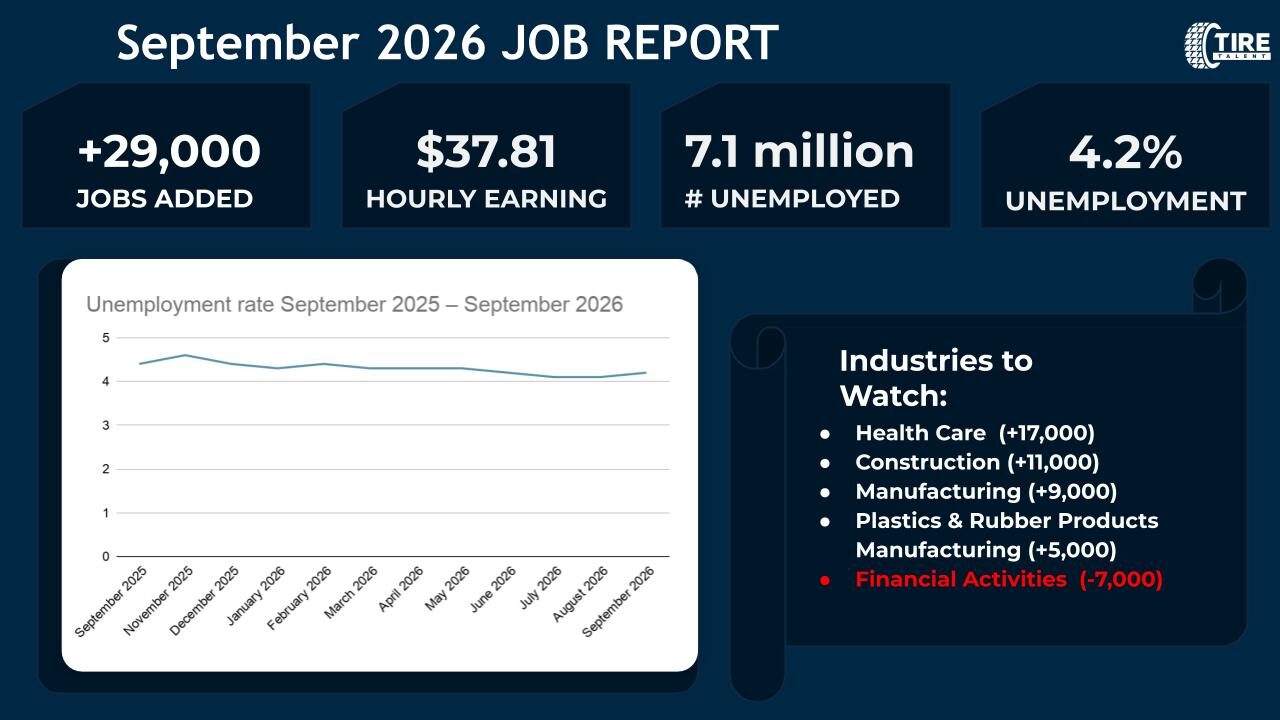
The September employment situation report, released October 2 by the Bureau of Labor Statistics, is a slow report nationally and a modestly encouraging one for the tire industry.
Total nonfarm payroll employment rose 29,000, well below the 45,000 average monthly gain over the prior twelve months. The unemployment rate was 4.2 percent, with 7.1 million people unemployed — a rate that has now stayed within a narrow 4.1 to 4.3 percent band since March. BLS described employment in all major industries as changing little over the month.
But the line item that matters most to this industry moved in the right direction. Employment in plastics and rubber products manufacturing — the category that contains tire manufacturing — rose by 5,000.
Here is what the report says about the tire sector, what it says about wages, and what both mean if you are hiring or job hunting this quarter.
The Tire Sector Number
Plastics and rubber products manufacturing added 5,000 jobs in September. That is the most direct read on tire manufacturing employment that BLS publishes at this level of detail, and it is the clearest positive in the report for this audience.
Machinery manufacturing also added 5,000. Manufacturing overall added 9,000 and is now up 72,000 since its recent low in December 2025.
For an industry that spent much of 2025 watching manufacturing employment drift sideways, nine months of net addition is a genuine change in direction. It is not a boom — 9,000 is a small number against a sector employing millions — but the trend line has turned.
The hours data fills in the picture usefully. The manufacturing workweek held at 40.6 hours and overtime held at 3.0 hours, down from 3.1 hours in the prior report. Read alongside the headcount gains, that combination suggests manufacturers are adding people rather than extending hours. Plants covering demand with overtime are converting it into headcount, which is what a plant manager would recognize as a staffing plan rather than a stopgap.
What Else Moved
Health care continued to add jobs (+17,000) but at roughly half its recent monthly average of 33,000, with gains in ambulatory services and hospitals offset by losses in nursing and residential care facilities (-9,000).
Construction added 11,000, close to its twelve-month average, with nonresidential specialty trade contractors continuing to trend up.
Financial activities lost 7,000 and is now down 129,000 since its May 2025 peak, with most of that decline concentrated in insurance carriers and related activities (-90,000). That is a sustained contraction in one sector rather than a broad signal.
Two household survey details are worth noting. Labor force participation edged up to 61.8 percent, the right direction after drifting lower through the first half of the year. And the number of people marginally attached to the labor force fell by 236,000 to 1.5 million — people who wanted work and had looked within the past year, moving either into jobs or out of the picture entirely.
Wage Growth Has Slowed Three Reports Running
The most durable signal in this release is one that is getting little attention.
Average hourly earnings rose 5 cents to $37.81, up 3.0 percent over the past twelve months. That is the slowest reading in this sequence: 3.2 percent two reports ago, 3.1 percent last month, 3.0 percent now.
Wage data gets revised far less dramatically than payroll counts, which makes a three-month directional trend here more reliable than anything in the headline number. For production and nonsupervisory employees — the group covering tire technicians, plant operators, and service staff — average hourly earnings rose 7 cents to $32.60, a slightly faster monthly gain than the all-employee figure.
Both Prior Months Were Revised Down
Each BLS release revises the two preceding months as additional employer reports arrive. This release revised both downward.
August, first reported as a 162,000 gain, is now 133,000. July, which had been revised up to a 21,000 gain in the previous release, is now a loss of 10,000. Together the two months are 60,000 jobs lower than previously published.
July is the clearest illustration of how much these estimates move: first published at -23,000, revised to +21,000, now standing at -10,000.
The practical implication is about decision-making rather than economics. A single month’s payroll print is an early estimate that routinely moves by tens of thousands in either direction. Employers who froze a search on a weak print and restarted it on a strong one have been reacting to noise. The usable signal is the trend across a quarter or more, and that trend currently shows a labor market adding roughly 30,000 to 45,000 jobs a month — well below the 2023 and 2024 pace, but not contracting.
What This Means for Tire Industry Employers
The softness in the national headline is not translating into an easier candidate market.
Unemployment at 4.2 percent has held in a narrow band since March. That is a stable, historically tight labor market rather than a loosening one. Meanwhile the industry category overlapping most directly with tire manufacturing is adding jobs, and machinery manufacturing — which draws maintenance technicians, controls specialists, and process engineers from the same regional pools as tire plants — is adding at the same rate.
Competitive pressure on skilled technical roles is therefore increasing slightly rather than easing. Every maintenance technician hired by a machinery manufacturer in your region is one fewer available to your plant.
The wage deceleration is the genuinely useful development for employers. Three percent annual growth is a slower-moving compensation target than the readings of two years ago, which makes compensation planning more predictable and reduces the risk that an offer approved in October is below market by January. It does not make candidates cheap. It means the ground is shifting more slowly underneath you.
What This Means for Tire Industry Job Seekers
For anyone working in tire manufacturing, this report is better for your sector than the national headline suggests.
Plastics and rubber products manufacturing is hiring. Manufacturing has added 72,000 jobs since December. Overtime is converting into headcount, which usually means plants are planning rather than patching. And wage growth of 3.0 percent, while slower than it was, remains positive.
The honest caveat is timing. Decelerating wage growth means the premium available from changing jobs is narrowing compared with a year or two ago. If you have been waiting on the assumption that the market will keep paying more to wait, the data no longer supports that. The leverage available now is better than the leverage likely available if wage growth slows further.
For commercial and OTR tire work, plant maintenance, and process engineering, that leverage remains real regardless of the monthly print. Those roles are hard to fill in any month.
The Bottom Line
September delivered a 29,000 payroll gain, a 4.2 percent unemployment rate, 3.0 percent wage growth, and downward revisions to both prior months. Nationally, this is a slow and hard-to-read labor market.
For the tire and automotive industry the signal is better than the headline. The sector category containing tire manufacturing added jobs. Manufacturing is nine months into a recovery from its December low. Hours are converting into headcount. And the people with real tire industry experience — technicians, plant talent, engineers — remain in a market that needs them more than the national numbers imply.
Tire industry employers with open roles: Connect with the Tire Talent recruiting team to discuss what the candidate market looks like in your region and how to close qualified candidates while competitors are still reading the headline.
Tire industry professionals exploring their options: Browse current opportunities at Tire Talent or reach out directly to find out what your experience is worth in the current market.