Tire plant automation is usually approved as an equipment decision. A capital case gets built around throughput, scrap reduction, and labor cost, the board signs it, the install date goes on the schedule, and procurement starts managing the project.
What almost never happens in that sequence is somebody rewriting the job descriptions.
The plant that installs automated tire building machines, robotic green tire handling, and machine vision inspection does not need fewer people in any simple sense. It needs measurably different people, in a different mix, with a skill profile that is harder to hire than the one being replaced. And the lead time on those people is longer than the lead time on the equipment.
That last point is the one worth sitting with. You can specify, order, and commission an automated line in nine to twelve months. You cannot reliably hire an experienced controls technician in nine months in most regional labor markets, and you cannot take a capable mechanical technician and make them a competent controls troubleshooter in that window either.
Capital has a shorter lead time than capability. Most automation disappointments trace back to that mismatch rather than to the equipment.
What Is Actually Being Automated
Worth grounding this, because “automation” covers a lot of ground and the workforce implications differ by stage.
In mixing and material handling, automated dosing systems and automated guided vehicles increasingly move compound and components between stages, replacing manual transport that previously consumed a meaningful share of labor hours.
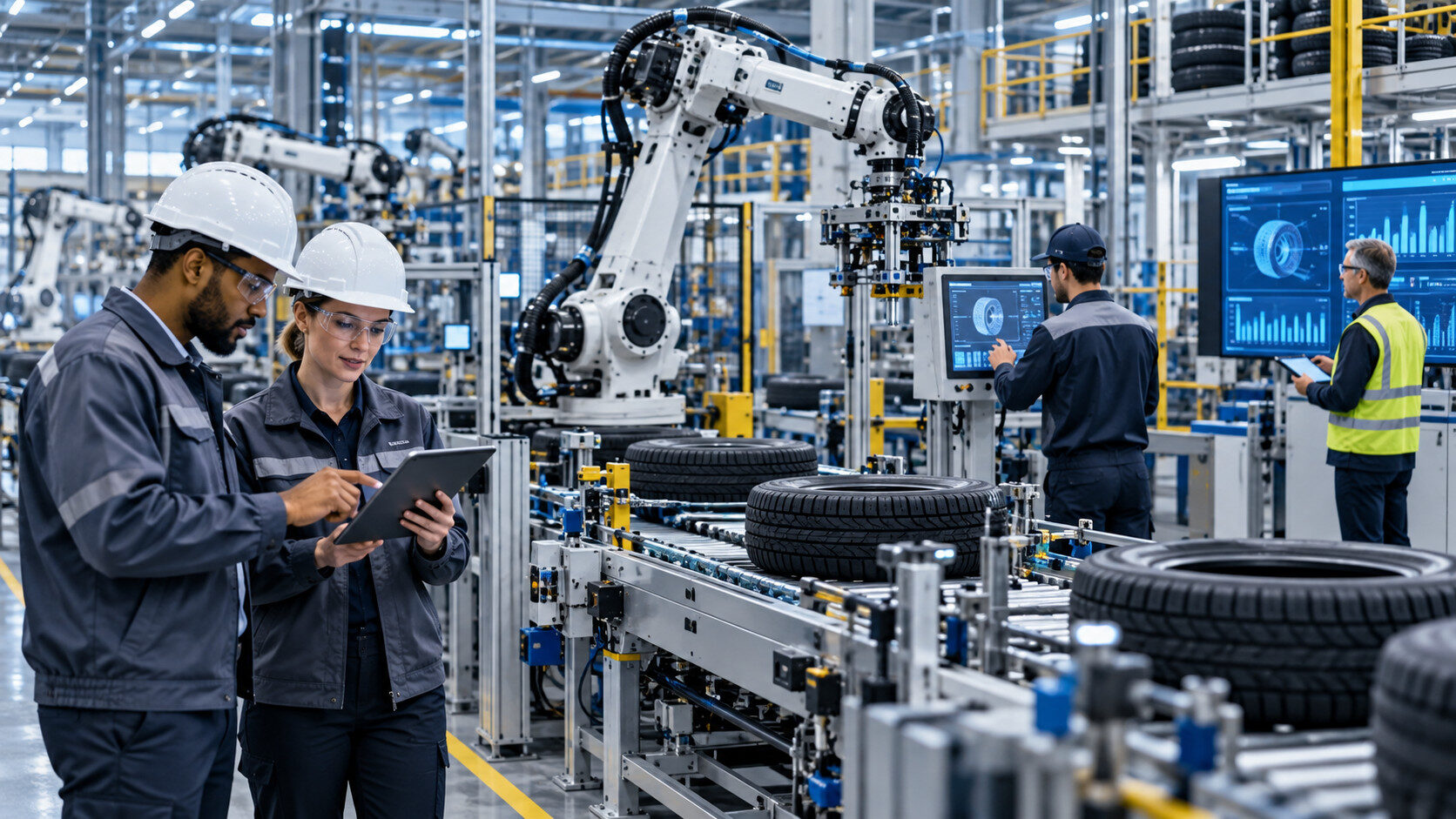
In component prep and building, automated tire building machines and robotic component handling have moved a job that was once heavily skill-dependent toward a machine-paced process with a human overseeing it.
Green tire handling has become one of the more heavily robotized areas — automated spraying, protective coating, high-point painting, and robotic transport of green tires to curing. AGV systems now handle a growing share of in-plant movement that used to be manual.
Curing has seen automated press loading and unloading spread widely, removing one of the more physically punishing jobs in the plant.
Inspection and final finish is where the change has been sharpest recently. Machine vision, 3D imaging, laser and ultrasonic measurement, and thermal imaging that captures infrared images of tire sections before and after inflation now perform work that was previously manual visual and tactile inspection. Manufacturers have been deploying AI-based automated inspection platforms designed to integrate into new facilities from the outset — Nexen launched one such system in late 2024.
Each of those changes a job. None of them eliminates the need for people who understand tires.
The Three Ways a Job Changes
It helps to sort roles into three categories rather than talking about automation replacing labor in general.
Roles that shrink in headcount. Repetitive material transport, manual press loading, and routine visual inspection are the clearest cases. These are real reductions and it is dishonest to pretend otherwise.
Roles that change character without shrinking much. The production operator is the main example. The job moves from performing the operation to monitoring it, recognizing when something is drifting, and deciding when to intervene or stop. Same headcount, different person.
Roles that grow and become harder to fill. Controls and automation maintenance, vision system support, and process engineering all expand. This is where automation concentrates your hiring difficulty, and it is almost always underestimated in the capital case.
The net labor cost may well fall. The net hiring difficulty almost always rises, because you are trading a category of role you could fill locally for a category you probably cannot.
Role by Role: What Actually Changes
Production Operators
The automated operator job is not a lesser version of the manual one. It is a different competency.
A manual tire builder was judged on consistency, speed, and craft. An operator on an automated building machine is judged on attention, pattern recognition, and judgment about when to stop. The failure mode has inverted: a manual operator producing a bad tire produces one bad tire, while an automated cell running out of spec produces bad tires continuously until somebody notices.
That makes the critical skill the ability to notice. Not to fix — to notice, and to be willing to stop a running line, which is partly a training question and substantially a culture question about whether stopping production gets you thanked or questioned.
For hiring, this shifts the profile toward mechanical aptitude, comfort with HMIs and tablets, conscientiousness, and communication, and away from manual dexterity. It also means you can recruit from a wider pool than traditional tire building allowed, which is one of the genuine upsides.
Maintenance Technicians
This is the pivot point of the whole transition, and where plants get hurt most.
An automated tire plant’s uptime depends on technicians who can troubleshoot across mechanical, electrical, pneumatic, hydraulic, servo, and controls systems. The mechanically excellent technician who cannot read ladder logic, interpret a fault code on an Allen-Bradley or Siemens platform, or work through a servo tuning problem becomes insufficient for the plant’s most critical failures — not through any fault of their own, but because the equipment changed underneath them.
The electrical-mechanical combination profile is consistently the most sought-after and least available in industrial maintenance, and every manufacturer automating anything is competing for the same people. Tire plants are not competing only with other tire plants for these technicians. They are competing with EV battery facilities, food and beverage, packaging, and every other sector installing automation in the same region.
Two implications for hiring. First, the controls-capable technician commands a premium and knows it, and a plant that upskills a technician without adjusting their pay has trained someone for a competitor. Second, this role should be hired ahead of the install, not after, for reasons covered below.
Quality Inspectors
This is the role plants most often get wrong, because the assumption is that vision systems replace inspectors.
What vision systems actually do is handle volume and consistency on defined defect types, at speeds and repeatability no human matches. What they do not do well is adjudicate the ambiguous case, recognize a novel defect mode the system was never trained on, or decide whether a borderline reading reflects a real problem or a sensor artifact.
Those judgments still require someone with years of tire knowledge. And the system needs that person for a second reason: automated inspection platforms require ongoing tuning and retraining, and the quality of that retraining depends entirely on the expertise of whoever is adjudicating the flagged cases.
A plant that eliminates its experienced inspectors on install day keeps the hardware and loses the judgment that makes the hardware accurate. The better move is to retain the strongest inspectors, move them to exception handling and system ownership, and treat that as a promotion with a pay step, because the role now requires more expertise rather than less.
Controls and Automation Engineering
Most tire plants that automate discover they need automation capability on staff, having planned to rely on OEM service contracts.
The problem with the service contract model is response time. When an automated cell is down and the vendor’s technician is a day away, the plant absorbs that downtime at full cost. Plants that run significant automation without in-house controls capability end up either over-buying service coverage or accepting downtime they could have prevented.
This creates a role many tire plants have never hired for: a controls engineer or senior automation technician who owns the PLC and HMI programs, manages vision system configuration, maintains the integration between cells, and handles the problems that would otherwise be a vendor call. It is an expensive hire and it is usually cheaper than the alternative.
Supervisors
Less obvious but real. A supervisor on a manual line manages a people problem: attendance, pace, quality, conflict. A supervisor on an automated line still manages that, plus a different failure mode — when the line stops, the question is technical, and the supervisor needs enough literacy to triage whether this is a two-minute reset, a maintenance call, or a controls issue.
Supervisors without that literacy either escalate everything, which wastes technician time, or wait too long, which wastes production time. It is a trainable skill and it is rarely included in the automation project plan.
The Hiring Mistakes Plants Make During Automation
Writing the new job description as the old one with “must be comfortable with technology” appended. The role genuinely changed. The posting should describe the new work, name the equipment and controls platform, and screen for the skills that now matter. A posting that reads like the pre-automation version will attract pre-automation candidates.
Assuming the OEM’s training week creates competence. Vendor commissioning training is necessary and nowhere near sufficient. It produces people who can run the equipment when it behaves, not people who can diagnose it when it doesn’t.
Cutting headcount on the equipment timeline rather than the capability timeline. The reduction assumed in the capital case arrives when the plant can actually run the line well. Taking the headcount out on install day, before the capability exists, is how a new line ends up running below rated output for a year.
Relying entirely on vendor support instead of building in-house capability. Defensible for a single cell, increasingly indefensible as automation spreads across the plant.
Not paying for the new skill. A technician you trained onto your controls platform is now more valuable in the regional market than they were before. If their pay doesn’t reflect that, you have effectively funded a competitor’s hiring. Build the pay step into the project budget, not the following year’s merit cycle.
Start the Capability Twelve Months Before the Line Arrives
The practical sequence, working backward from install.
Twelve months out: identify which current technicians have the aptitude and interest to become controls-capable, and start them on training now. This is the longest lead item and the one most often started last.
Nine to twelve months out: hire the controls technician or engineer. The single best training opportunity that will ever exist for this role is participating in the commissioning of your own equipment, and it is available only if they are on staff before the install. Hiring them after start-up means paying the same salary for substantially less system knowledge.
During the capital negotiation: get training scope and documentation quality into the purchase agreement rather than treating them as afterthoughts. Specify how many of your people get trained, to what standard, on what schedule, and what documentation you receive. This has real leverage while the order is unsigned and none afterwards.
Six months out: rewrite the affected job descriptions and post the roles you need. Also decide, explicitly, which experienced inspectors and operators you are retaining and repositioning rather than releasing.
Before start-up: define and communicate the pay progression for the new skills, so the people you are asking to change roles can see what changing is worth.
For context on what the roles above and around this transition pay, our tire industry salary guide covers the current ranges, and the broader shortage dynamics are set out in our analysis of the tire technician shortage.
If You Work in a Plant That’s Automating
The same analysis read from the other side produces a fairly clear set of moves.
If you are a maintenance technician, controls capability is the highest-return skill investment available to you right now, and the window is favorable. Ladder logic, fault diagnosis on Allen-Bradley or Siemens platforms, servo and drive systems, and vision system basics move you from the category of technician plants can find to the category they cannot. Volunteer for the automation project, ask to be on the commissioning team, and take the vendor training even if it lands on an inconvenient week. Commissioning access is the most valuable training available and it disappears once the line is running.
If you are a production operator, the transition is not a threat to be waited out, but it does reward initiative. Operators who learn the HMI properly, understand what the machine is actually doing rather than which buttons produce which result, and build a reputation for catching problems early are the ones who move into monitoring and troubleshooting roles instead of being reassigned. Ask to be trained on the new equipment before the layoff conversation rather than after.
If you are a quality inspector, your tire knowledge becomes more valuable, not less, but only if you can apply it to the new system. Learn how the vision or thermal system makes its calls, get involved in tuning it, and become the person who adjudicates the borderline cases. That is a defensible and better-paid position than manual inspection was.
And a practical note for all three: once you hold controls or automation skills, your market value changes immediately, whether or not your employer adjusts your pay. Plants that train people and don’t reprice them lose them, routinely. Knowing what the skill is worth externally is reasonable diligence, not disloyalty.
Frequently Asked Questions
Does tire plant automation reduce headcount?
In specific roles, yes — manual material transport, press loading, and routine visual inspection typically shrink. But the plant simultaneously needs more controls and automation maintenance capability, vision system support, and process engineering, and those roles are harder and more expensive to fill than the ones reduced. Net labor cost often falls while net hiring difficulty rises.
What skills do tire plants need after automating?
The scarce profile is combined electrical and mechanical troubleshooting: PLC and HMI work on Allen-Bradley or Siemens platforms, servo and drive systems, vision system configuration, and integration between automated cells, alongside conventional mechanical, hydraulic, and pneumatic skills. For operators, the priority shifts to monitoring, pattern recognition, and the judgment to stop a line. For quality, tire expertise becomes more valuable because someone has to adjudicate what the vision system flags.
Should we hire controls technicians before or after installing automation?
Before, ideally nine to twelve months ahead. Participating in the commissioning of your own equipment is the most effective training a controls technician will ever get on that specific system, and it is only available if they are employed before the install. Hiring after start-up costs the same salary for materially less system-specific knowledge and leaves the plant dependent on vendor response times during the hardest period.
Do machine vision systems replace quality inspectors in tire plants?
No, though they change the job substantially. Vision and thermal inspection systems handle volume and consistency on known defect types far better than people. They handle ambiguous cases, novel defect modes, and sensor artifacts poorly, and they require ongoing tuning that depends on expert human adjudication. Plants that release experienced inspectors at install lose the judgment the system needs to stay accurate.
The Bottom Line
Tire plant automation is a workforce project wearing an equipment project’s clothing. The machines arrive on schedule because somebody managed a procurement timeline. The capability to run them well arrives late because nobody managed a hiring and training timeline in parallel.
The fix is not complicated, just early. Decide which technicians become controls-capable and start them now. Hire the automation talent before the install so they learn the system while it is being built. Negotiate training into the purchase. Rewrite the job descriptions to describe the actual new work. Keep the inspectors whose judgment the vision system depends on. And pay for the skills you are asking people to acquire, before someone else does.
For tire manufacturers staffing an automation project: connect with the Tire Talent team to discuss sourcing controls technicians, automation maintenance talent, and plant engineering — the roles that determine whether new equipment performs to its business case.
For maintenance technicians, controls specialists, and plant engineers: browse current opportunities at Tire Talent or reach out confidentially to find out what your controls and automation experience is worth in the current market.