
Key Takeaways
- 55% of tire businesses report difficulty filling open roles, especially technicians, service managers, and sales leaders.
- The tire industry labor shortage is driven by demographic shifts, skills gaps, and outdated hiring models.
- Compensation alone is no longer enough career visibility, culture, and leadership quality now matter just as much.
- Tire companies that modernize recruiting, invest in managers, and widen their talent lens are winning the hiring battle.
- Fixing the talent gap requires systemic change, not quick fixes.
Why Is the Tire Industry Labor Shortage So Severe Right Now?
The tire industry labor shortage didn’t appear overnight. It has been building quietly for more than a decade and now it’s reaching a breaking point.
According to industry surveys, workforce studies, and Tire Business reporting, more than 55% of tire retailers, manufacturers, and distributors say they cannot fill open positions, even with competitive pay. These shortages span:
- Tire technicians
- Retread and manufacturing operators
- Service managers
- Store managers and district leaders
- Sales and commercial account roles
What’s changed is not just the number of available workers but who the modern workforce is, what they expect, and how tire businesses are trying (and failing) to recruit them.
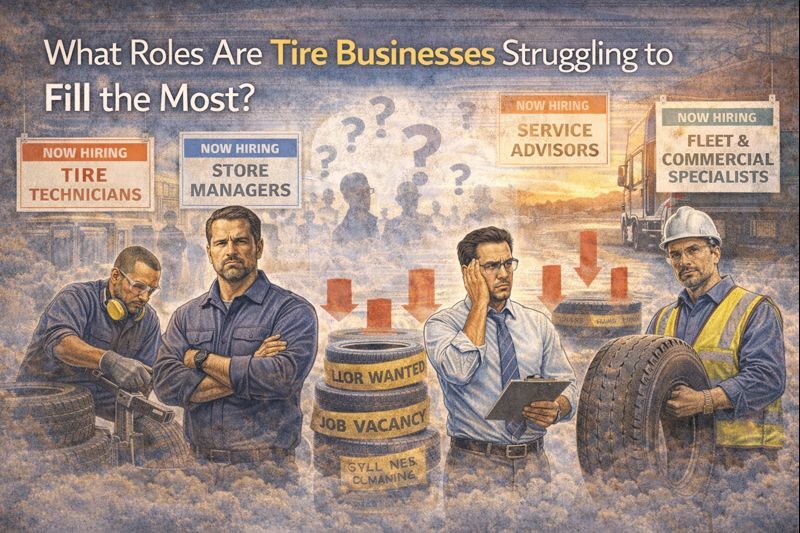
What Roles Are Tire Businesses Struggling to Fill the Most?
1. Tire Technicians and Service Techs
Entry-level and mid-level technician roles remain the hardest to fill. Reasons include:
- Physically demanding work
- Perceived lack of long-term career growth
- Competition from construction, logistics, utilities, and HVAC
- Fewer young workers entering the trades
The average age of a tire technician continues to rise, while replacement pipelines shrink.
2. Store Managers and Front-Line Leaders
The second major pressure point is leadership.
Many tire businesses promoted strong technicians into management roles without providing:
- Leadership training
- People-management skills
- Coaching support
- Clear authority
The result? Burned-out managers and high turnover, which only worsens the labor shortage.
3. Commercial Sales and Account Managers
As fleets consolidate and customers become more sophisticated, tire businesses need sales talent that understands:
- Fleet economics
- Preventive maintenance
- Data-driven selling
- Relationship management
That talent often exists but not inside traditional tire recruiting channels.
What’s Really Causing the Tire Industry Labor Shortage?
1. Demographics Are Working Against the Industry
Baby Boomers who make up a large share of experienced tire professionals are retiring faster than they are being replaced.
At the same time:
- Gen Z is smaller than previous generations
- Fewer young workers are entering skilled trades
- Many don’t see tire work as a “career,” only a job
Without intervention, this gap will widen through 2030.
2. Outdated Hiring Models Are Failing
Many tire businesses still rely on:
- Walk-in applicants
- Generic job boards
- Word-of-mouth referrals
- Reactive hiring
These approaches no longer work in a tight labor market where top candidates are already employed.
3. The Industry Sells the Job Not the Career
One of the biggest mistakes tire businesses make is failing to articulate:
- Career progression paths
- Leadership opportunities
- Income growth over time
- Skill development
Candidates don’t leave because tire work is hard.
They leave because they can’t see where the road leads.
4. Poor Managers Drive Turnover
Study after study shows that people don’t quit companies, they quit managers.
In tire businesses, undertrained managers often struggle with:
- Scheduling fairly
- Giving feedback
- Coaching performance
- Resolving conflict
This creates churn that cancels out recruiting efforts.
How Much Is the Tire Industry Labor Shortage Really Costing Businesses?
The cost of unfilled roles goes far beyond overtime.
Hidden costs include:
- Lost sales from understaffed stores
- Longer wait times and poor customer experience
- Technician burnout and injuries
- Increased safety risks
- Missed expansion opportunities
Industry estimates suggest that one vacant technician role can cost a tire business $100,000+ annually in lost revenue and productivity.
Multiply that across multiple locations, and the impact is massive.
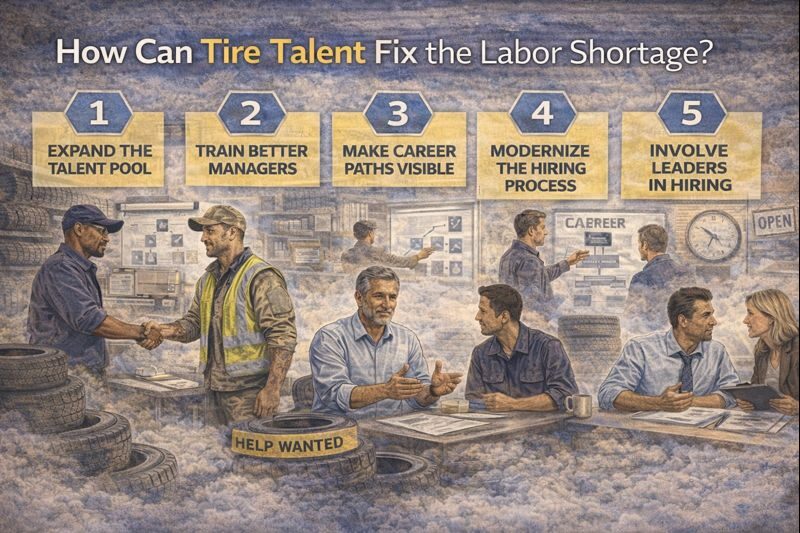
How Can Tire Talent Fix the Labor Shortage?
The good news: companies that adapt are already seeing results.
Here’s what’s working.
1. Expand the Talent Pool Beyond “Tire Experience”
The most successful tire employers are hiring from adjacent industries:
- Automotive service
- Heavy equipment
- Manufacturing
- Military mechanics
- Fleet maintenance
- Warehousing and logistics
Skills transfer faster than most employers realize if onboarding and training are structured correctly.
2. Invest in Front-Line Leadership Training
Retention improves dramatically when managers are trained to:
- Coach instead of command
- Communicate expectations clearly
- Handle conflict early
- Support work-life balance
Strong managers are the single biggest lever for reducing turnover.
3. Make Career Paths Visible and Real
Top tire businesses now show candidates:
- Technician → Lead Tech → Manager pathways
- Sales → Regional → Leadership tracks
- Estimated income growth over 3–5 years
- Certifications and training milestones
When people can see the future, they stay.
4. Modernize the Hiring Process
Winning employers:
- Move faster than competitors
- Reduce interview friction
- Communicate clearly and often
- Treat candidates like customers
In a labor shortage, speed and respect win.
5. Stop Treating Hiring as an HR Problem
Hiring is a leadership issue, not an HR task.
When owners, VPs, and operators are involved in:
- Defining role outcomes
- Interviewing key hires
- Supporting managers
Hiring outcomes improve dramatically.
What Will Happen If Tire Businesses Don’t Fix This?
If nothing changes, the tire industry labor shortage will:
- Limit growth and expansion
- Increase consolidation pressure
- Push customers toward competitors
- Burn out remaining employees
- Force reactive, expensive hiring decisions
In contrast, companies that treat talent as a strategic advantage will dominate their markets.
Why This Matters More in 2026 and Beyond
The tire industry is facing:
- Increased automation
- Electrification and EV complexity
- More sophisticated fleet customers
- Rising safety and compliance expectations
None of this is possible without the right people in the right roles.
The companies that solve hiring first will be the ones still standing later.
Final Thoughts: Fixing the Tire Industry Labor Shortage Is Possible
The tire industry labor shortage is real but it’s not unsolvable.
It requires:
- Rethinking where talent comes from
- Supporting front-line leaders
- Selling careers, not jobs
- Treating hiring as a business strategy
The tire businesses that act now won’t just fill roles; they’ll build resilient teams that outperform competitors for years to come.