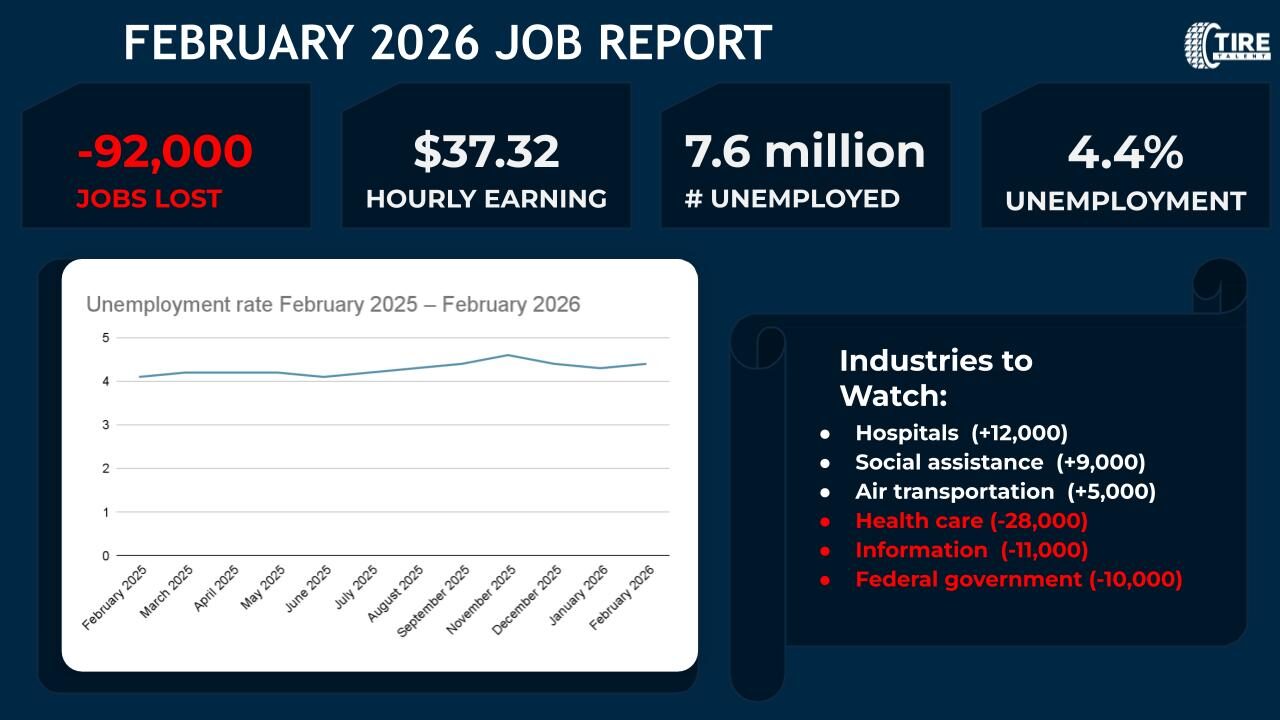
The U.S. labor market showed further signs of slowing in February 2026 as total nonfarm payroll employment declined by 92,000 jobs, according to the latest report from the U.S. Bureau of Labor Statistics.
While the unemployment rate remained relatively stable at 4.4%, the unexpected drop in payrolls highlights the fragile state of hiring momentum entering the spring. The decline follows a revised January gain of 126,000 jobs, signaling a labor market that continues to struggle with uneven demand across sectors.
For manufacturers, distributors, and companies in the broader tire and automotive supply chain, the February report reinforces a growing theme in the labor market: slow hiring, targeted workforce adjustments, and rising caution among employers.
February 2026 Jobs Report: Key Numbers
- Total Nonfarm Payroll Change: –92,000
- Unemployment Rate: 4.4%
- Total Unemployed: 7.6 million
- Average Hourly Earnings: $37.32 (+0.4% month-over-month)
- Year-over-Year Wage Growth: 3.8%
- Labor Force Participation Rate: 62.0%
- Average Workweek: 34.3 hours
The decline in payrolls comes alongside downward revisions to previous months, further reinforcing the narrative of a labor market losing momentum.
- December revision: +48,000 → –17,000
- January revision: +130,000 → +126,000
Combined, those revisions erased 69,000 jobs from earlier estimates.
Sector Breakdown: Where Jobs Were Lost
The February report shows a labor market where hiring remains highly uneven across industries.
Health Care
Healthcare employment fell by 28,000 jobs, largely due to strike activity affecting physicians’ offices.
Offices of physicians alone lost 37,000 jobs, while hospitals added 12,000 positions.
Despite the monthly decline, healthcare remains one of the strongest long-term job growth sectors, averaging 36,000 new jobs per month over the past year.
Information Sector
The information industry continued its downward trend, shedding 11,000 jobs in February.
Over the past 12 months, the sector has lost an average of 5,000 jobs per month, reflecting ongoing restructuring in technology, media, and digital services.
Federal Government
Federal employment declined by 10,000 jobs in February and has now fallen 330,000 jobs since October 2024, representing an 11% reduction in the federal workforce.
This contraction continues to ripple through related industries and contractor ecosystems.
Transportation & Warehousing
Transportation and warehousing employment fell by 11,000 jobs, driven largely by losses in courier and messenger services.
The sector has now declined by 157,000 jobs since February 2025, representing a 2.4% drop in employment.
For companies connected to freight, logistics, and distribution, the trend reflects weaker shipment volumes and normalization after the pandemic logistics boom.
Areas Showing Growth
Despite the overall payroll decline, some sectors still added workers.
Social Assistance
Social assistance added 9,000 jobs, continuing its steady upward trajectory.
Most of the growth came from individual and family services, which added 12,000 jobs.
Manufacturing and Construction
Employment in manufacturing and construction remained largely unchanged, suggesting a stabilization phase rather than a sharp contraction.
For industrial sectors, including tire manufacturing and equipment production, this steady employment level indicates companies are holding onto skilled labor despite softer demand.
Labor Market Participation Remains Stagnant
The labor force participation rate slipped slightly to 62.0%, while the employment-population ratio declined to 59.3%.
Both measures have shown little meaningful improvement over the past year.
This suggests that while layoffs remain limited, the labor market is not drawing large numbers of workers back into employment either.
Underemployment Shows Some Improvement
One of the more positive indicators in the February report was the drop in underemployment.
The number of people working part time for economic reasons fell by 477,000 to 4.4 million.
These workers would prefer full-time jobs but are currently working reduced hours or unable to secure full-time employment.
The decline suggests some stabilization in work hours, even as hiring slows.
Long-Term Unemployment Continues to Rise
While the overall unemployment rate held steady, the number of long-term unemployed workers remained elevated at 1.9 million.
This represents a notable increase from 1.5 million a year earlier, highlighting the difficulty some workers face in re-entering the labor force after extended unemployment.
Long-term unemployed workers now represent 25.3% of all unemployed individuals.
Wage Growth Remains Stable
Average hourly earnings increased by $0.15 in February, bringing the average wage to $37.32 per hour.
Over the past year, wages have increased 3.8%, maintaining a moderate pace that continues to ease inflation pressure while still supporting income growth.
For production and nonsupervisory employees, wages rose $0.09 to $32.03 per hour.
The Bigger Picture: A Cooling but Stable Labor Market
Taken together, the February report paints a picture of a labor market that is cooling rather than collapsing.
Hiring remains selective, wage growth is moderating, and several industries are adjusting their workforce levels after years of rapid expansion.
For leaders across the tire, automotive, and manufacturing supply chains, the key takeaway is that 2026 is shaping up to be a year of labor market recalibration rather than rapid growth.
Employers are balancing caution with stability, maintaining core talent while waiting for clearer economic signals before accelerating hiring again.