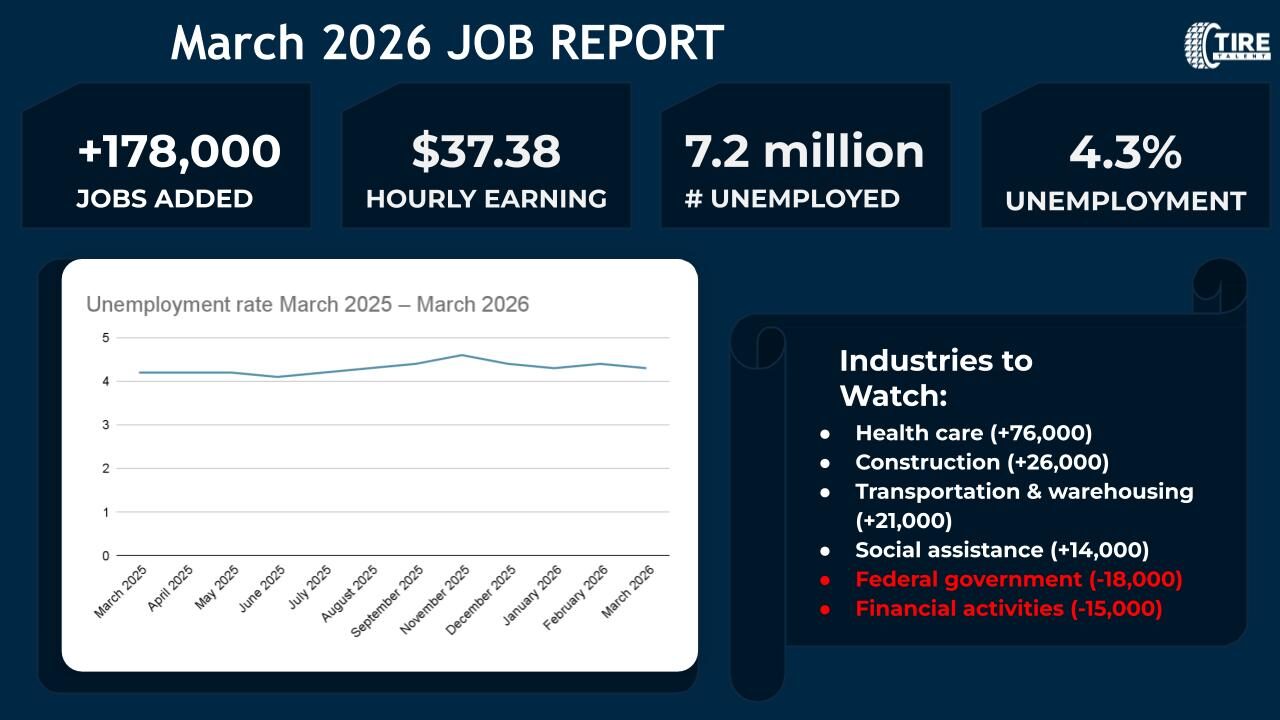
The March 2026 jobs report shows the U.S. economy added 178,000 jobs, according to the U.S. Bureau of Labor Statistics.
This follows February’s revised –133,000 job loss, marking a clear rebound in hiring.
The unemployment rate remained at 4.3%, while wages continued to grow modestly.
At first glance, the March 2026 jobs report signals improvement.
But the bigger question is:
Is the labor market actually gaining momentum or just stabilizing?
Key Takeaways from the March 2026 Jobs Report
- +178,000 jobs added in March
- Unemployment steady at 4.3%
- Wage growth at 3.5% year-over-year
- Hiring concentrated in select sectors
- Overall labor market remains stable, not accelerating
A Rebound Not a Breakout
The March 2026 jobs report shows a strong recovery from February’s decline.
But context matters.
February’s numbers were revised lower, indicating the labor market was weaker than initially reported. March’s gain helps offset that decline but does not yet signal a new phase of strong growth.
Over the past year, job creation has been relatively flat.
The labor market hasn’t collapsed.
But it hasn’t meaningfully accelerated either.
This is not a hiring surge, it’s stabilization.
Labor Market Conditions in March 2026
The March 2026 jobs report highlights several key labor market indicators:
- Unemployment rate: 4.3%
- Unemployed workers: 7.2 million
- Long-term unemployed: 1.8 million
- Labor force participation rate: 61.9%
- Employment-population ratio: 59.2%
These metrics show limited change over time.
Meanwhile, the number of workers marginally attached to the labor force increased, along with discouraged workers.
This suggests the labor market is not expanding in a broad-based way.
Where Job Growth Is Concentrated
The March 2026 jobs report shows hiring concentrated in a few key sectors.
Job Gains
- Health care: +76,000
- Construction: +26,000
- Transportation & warehousing: +21,000
- Social assistance: +14,000
Job Losses
- Federal government: –18,000
- Financial activities: –15,000
A significant portion of the job growth came from healthcare, partly driven by workers returning after strike activity.
Meanwhile, industries tied to manufacturing and the tire supply chain showed limited movement.
This reinforces a key trend:
Hiring is happening but it is not broad-based.
Wage Growth and Work Hours
The March 2026 jobs report also shows continued moderation in wage growth:
- Average hourly earnings: $37.38 (+0.2%)
- Year-over-year wage growth: 3.5%
- Average workweek: 34.2 hours
This slower wage growth reduces cost pressure for employers, but also reflects softer demand for labor.
What the March 2026 Jobs Report Means for the Tire Industry
For companies across the tire and automotive sectors, the March 2026 jobs report confirms what many leaders are already experiencing.
The hiring environment remains challenging:
- Skilled technicians and operators are still difficult to find
- Turnover remains historically low
- Hiring demand exists but talent supply remains constrained
In this environment, the issue isn’t just hiring demand.
It’s talent availability.
Experienced professionals are staying in their current roles, limiting movement across the labor market.
This creates a competitive hiring environment, even as overall job growth remains moderate.
The Bigger Picture
The March 2026 jobs report does not signal a breakout in hiring.
Instead, it reinforces a broader trend:
The labor market is stable, cautious, and slow-moving.
Employers are hiring carefully.
Workers are staying put.
And overall momentum remains limited.
Outlook: Stabilizing, Not Accelerating
The key takeaway from the March 2026 jobs report is clear:
The labor market is not weakening sharply but it is not accelerating either.
It is stabilizing.
For business leaders, that means workforce strategy in 2026 should focus on:
- Retention and employee engagement
- Structured hiring processes
- Building long-term talent pipelines
Because in this environment, success will not come from hiring more people.
It will come from hiring the right people.