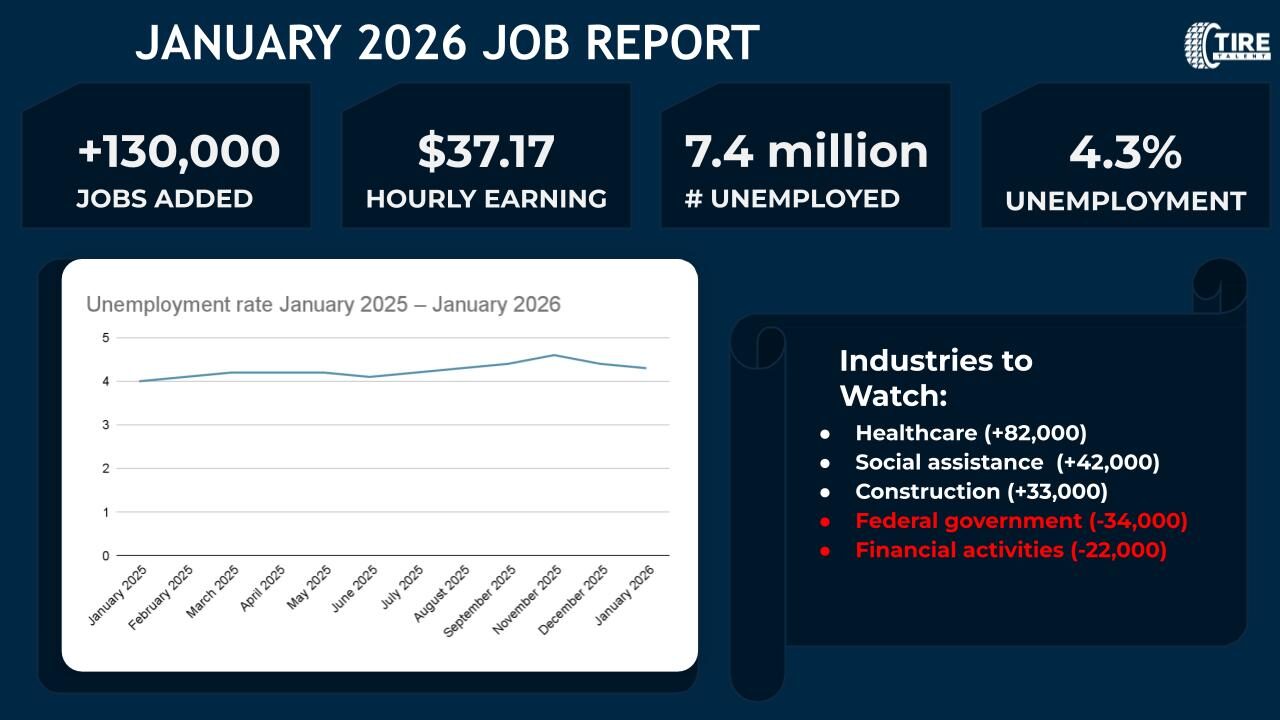
The January 2026 jobs report shows the U.S. economy added 130,000 jobs, while the unemployment rate held steady at 4.3%, according to the latest data from the U.S. Bureau of Labor Statistics.
After a weaker finish to 2025, January’s hiring rebound signals a labor market that is stabilizing but not accelerating as the economy enters 2026.
For employers in the tire and industrial sectors, this report provides important insight into workforce planning, hiring strategy, and labor cost management for the year ahead.
January 2026 Jobs Report: Key Data Points
- +130,000 jobs added
- Unemployment rate: 4.3%
- 7.4 million unemployed workers
- Average hourly earnings: $37.17
- Wage growth: +3.7% year-over-year
- Labor force participation: 62.5%
While job growth improved compared to December, hiring remains below the pace seen in 2024, confirming that the U.S. labor market has entered a lower-growth phase.
Where Job Growth Is Concentrated
The January 2026 jobs report shows hiring remains concentrated in a few key sectors:
Industries Adding Jobs
- Healthcare: +82,000
- Social assistance: +42,000
- Construction: +33,000
Construction job growth is particularly relevant to the tire industry, as infrastructure and commercial projects support demand for commercial fleet and specialty tires.
Industries Losing Jobs
- Federal government: –34,000
- Financial activities: –22,000
Meanwhile, manufacturing, retail trade, transportation, and wholesale sectors showed little change reinforcing a steady but cautious business environment.
Unemployment and Long-Term Labor Trends
Although the unemployment rate edged down to 4.3%, it remains higher than a year ago.
- Long-term unemployed: 1.8 million
- Representing 25% of total unemployed
- Up significantly year-over-year
The number of workers employed part-time for economic reasons fell to 4.9 million, indicating slight improvement in underemployment though still elevated compared to 2024.
For tire employers, this suggests labor availability has loosened slightly, but skilled technicians and operational leaders remain competitive hires.
Wage Growth and Cost Implications
Wage growth continued to moderate in January:
- +0.4% month-over-month
- +3.7% year-over-year
For tire manufacturers and dealers, moderating wage growth offers improved predictability in labor cost planning. However, top-tier mechanical, operational, and leadership talent continues to command premium compensation.
The average workweek also increased slightly to 34.3 hours, suggesting stable demand conditions rather than contraction.
What the January 2026 Jobs Report Means for Tire Industry Hiring
The labor market entering 2026 can best be described as:
- Stable but selective
- Expanding in service-driven sectors
- Flat in manufacturing and retail
- Not signaling recession
For tire industry employers, this environment favors:
Retention Over Rapid Expansion
Protect skilled technicians, plant supervisors, and leadership roles.
Targeted Hiring
Focus on revenue-driving and productivity-enhancing positions.
Strategic Workforce Planning
Avoid reactive hiring. Align headcount growth with demand forecasts.
Operational Efficiency
In a lower-growth labor market, productivity becomes the competitive advantage.
Outlook for 2026
The January 2026 jobs report suggests the U.S. labor market is stabilizing after late-2025 cooling, but remains well below the momentum seen during stronger expansion periods.
For the tire industry, this means planning for:
- Controlled hiring growth
- Margin discipline
- Demand-aligned workforce expansion
- Strategic leadership recruitment
The labor market is not collapsing. It is recalibrating.
And in a recalibrated economy, disciplined workforce strategy wins.