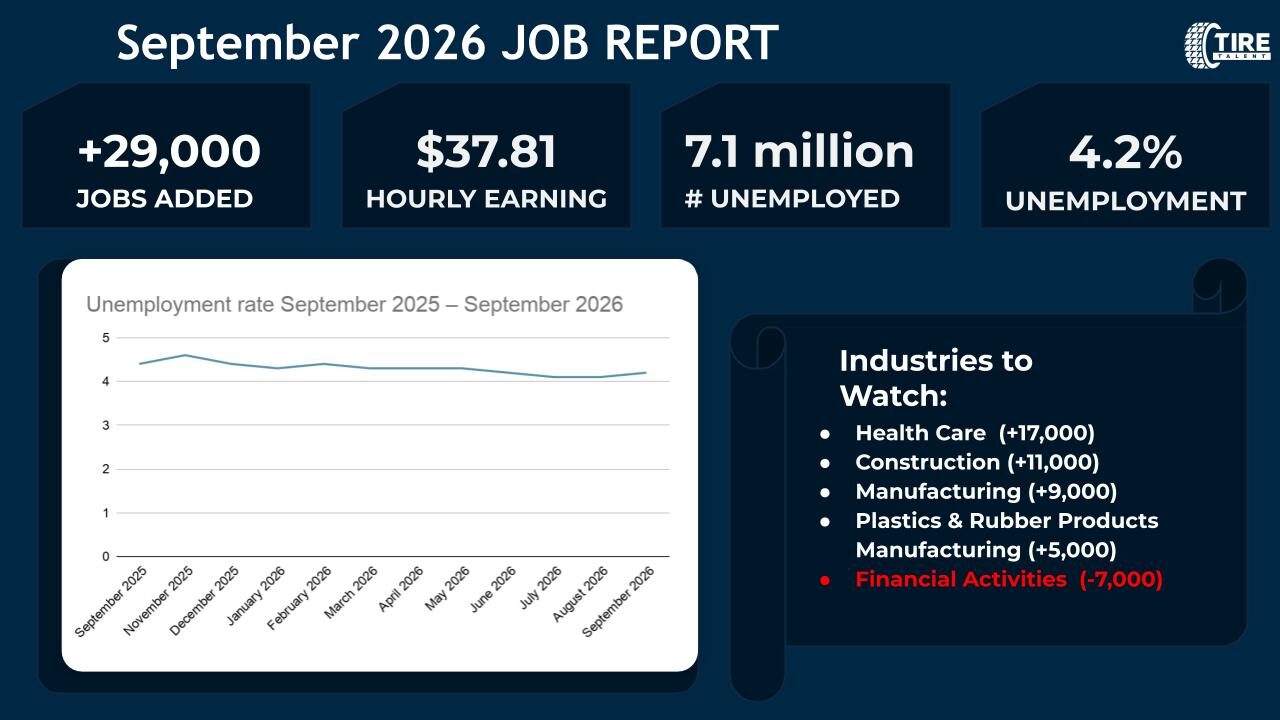
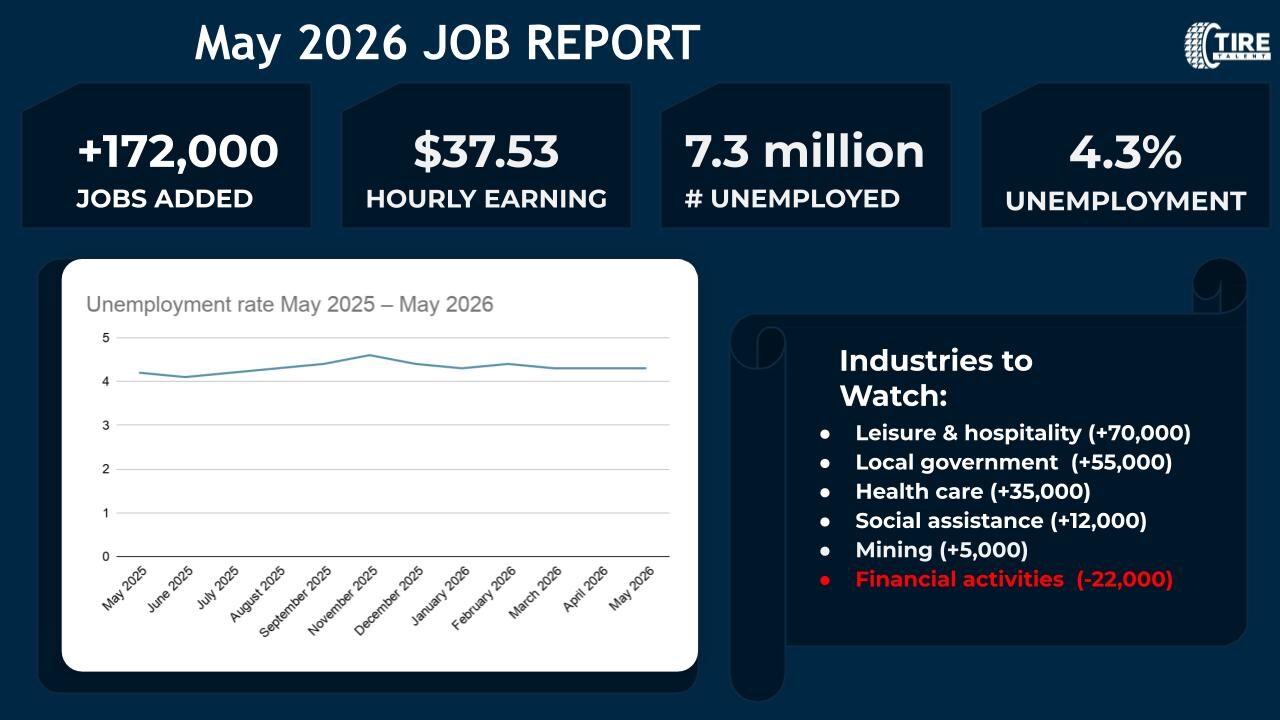
The May 2026 jobs report landed with a headline that looks solid on the surface — 172,000 nonfarm payroll jobs added, unemployment unchanged at 4.3 percent — but for tire dealers and automotive service operators, the numbers underneath tell a more specific story about the market you’re hiring and operating in right now.
Here’s what matters and what it means for your shop.
The Economy Is Still Hiring — and Consumers Are Still Driving
172,000 jobs added in May is a steady number. It’s not a blowout, but it’s not a warning sign either. When you add the upward revisions to March (+29,000) and April (+64,000) — a combined 93,000 more jobs than originally reported — the picture is of an economy that kept growing through Q2 even as fears of a slowdown circulated.
For tire dealers, this matters for one simple reason: employed people drive. They commute, they take road trips, they defer less on tire replacements and brake jobs when they’re earning a paycheck. The fact that consumers remain broadly employed is a direct input to service demand at your shop.
Leisure and hospitality led May with 70,000 new jobs — nearly five times its 12-month monthly average of 14,000. More travel, more miles, more wear. That’s your market.
The Unemployment Rate Confirms What You Already Know About Hiring
4.3 percent unemployment. That number has barely moved since July 2025 — stuck in a 4.3–4.5 percent range for nearly a full year.
In practical terms, that means the experienced tire technicians you’re looking to hire are almost certainly employed. They are not scanning Indeed. They are not responding to your job posting unless something specific about your shop gives them a reason to reach out. The BLS data backs up what every tire dealer hiring right now already feels: the candidate pool is thin, experienced technicians are passive, and the shops winning those hires are the ones making direct contact — not waiting for applications.
Long-term unemployment (27 weeks or more) is at 2.0 million and has risen 524,000 over the past year. That’s a reminder that there is a hidden talent pool out there — workers who’ve been out of the market for a while, some of whom have transferable skills and are genuinely available. Entry-level technician and service advisor roles are exactly the right target for this cohort if you’re willing to train.
Wages Are Still Rising — and Techs Know It
Average hourly earnings for private sector workers rose to $37.53 in May, up 3.4 percent over the year. For production and nonsupervisory workers — the category that most closely tracks your technician workforce — earnings hit $32.31, up 0.2 percent for the month.
That 3.4 percent annual wage growth is the number to benchmark against. If your pay scales haven’t moved at least 3 percent since last May, you are paying below market in real terms — not because your pay went down, but because the market went up without you. Technicians who are aware of the market (and they are) will notice.
The manufacturing workweek held at 40.4 hours with 3.1 hours of overtime. That’s shops and facilities running lean and squeezing productivity from existing headcount rather than adding staff. Sound familiar?
Transportation Was Flat — Commercial Tire Demand Is Stable
Transportation and warehousing employment was essentially unchanged in May (+1,000). That’s not growth, but it’s also not contraction. For dealers who service commercial fleets and OTR customers, stable transportation employment means stable vehicle miles, stable commercial tire wear cycles, and stable demand for the commercial service capacity you’ve built.
The sector has been down 92,000 from its February 2025 peak, which is worth watching — but May’s flatline suggests the pullback has stabilized rather than continued.
The Hiring Takeaway for Tire Dealers in June 2026
The May jobs report doesn’t change the structural reality of tire technician hiring — it confirms it. Here’s the condensed version:
- Consumer spending is holding. Employed consumers service their vehicles. Demand at your shop is supported.
- The labor market is still tight. 4.3 percent unemployment means your best candidates are working elsewhere and not actively looking. Passive outreach beats job postings for experienced technicians.
- Wages rose 3.4 percent year over year. If your compensation hasn’t kept pace, your offers are losing before you make them.
- There is a long-term unemployed pool worth targeting. 2 million people out of work for 6+ months includes trainable candidates for entry-level roles dealers are struggling to fill.
A healthy economy that keeps adding jobs is good for your service volume. That same economy makes every hire harder because your candidates are employed. The shops that navigate this best are the ones with a proactive sourcing process — not a reactive one.
For tire dealers who need to hire faster: Connect with the Tire Talent team to reach employed technicians your job postings can’t access.
For tire technicians who want to know what the market is offering right now: Browse open roles at Tire Talent to see what dealers in your market are paying and offering in 2026.