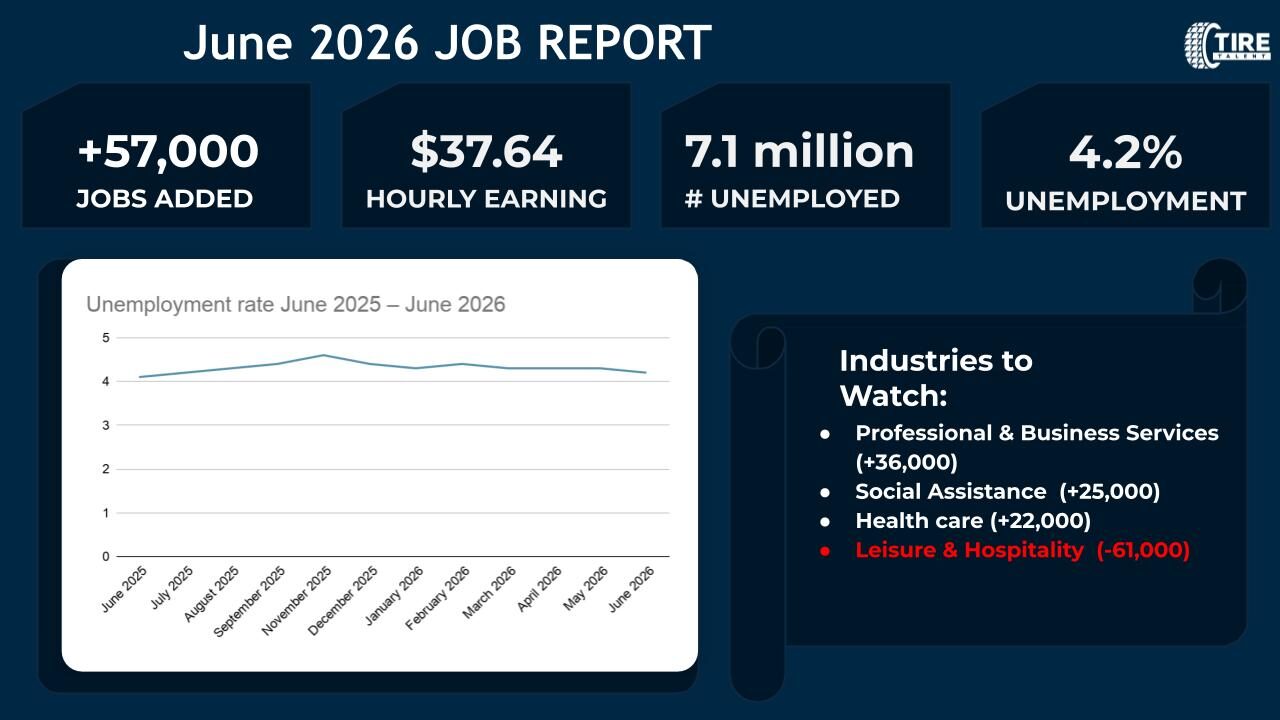
The Bureau of Labor Statistics dropped the June 2026 employment situation report on July 2nd, and the headline number turned heads. The U.S. economy added just 57,000 jobs last month — less than half of what economists had projected. With estimates sitting around 110,000, the actual figure landed well short. Unemployment held at 4.2%, a tick below the 4.3% forecast, but the broader picture was one of a labor market that’s cooling faster than most expected.
For anyone in the tire and automotive space — whether you’re hiring technicians, recruiting commercial sales reps, or mapping out your next career move — this report has real implications. Here’s what the numbers are actually saying, and what they mean on the ground.
The Headline Numbers
The economy generated 57,000 total nonfarm payroll jobs in June. Private employers accounted for 49,000 of those, with government jobs making up the remaining 8,000.
That soft number would be concerning on its own. But the revisions made it worse. April’s job gains were revised down by 31,000 (from 179,000 to 148,000), and May took a 43,000-job haircut (dropping from 172,000 to 129,000). Combined, that’s 74,000 jobs the economy was previously credited with that simply weren’t there.
Healthcare was the standout performer, adding 21,500 jobs, with hospitals alone contributing 9,200. Leisure and hospitality, which often inflates June numbers during seasonal hiring, actually dropped by 61,000 — a sign that the consumer spending that typically drives summer staffing didn’t materialize the way employers anticipated.
The labor force participation rate slipped 0.3 percentage points to 61.5%, and the employment-population ratio fell to 59%. The number of long-term unemployed climbed to 1.9 million, up 286,000 from a year ago. Average hourly earnings for private-sector production employees rose 7 cents, or 0.2%, to $32.38 — up 3.5% year-over-year.
What Happened in Manufacturing
Manufacturing added just 3,000 jobs in June — a rounding error by most measures. The BLS noted that manufacturing showed “little or no change over the month,” the same language used for oil and gas, construction, retail, and transportation.
The manufacturing workweek edged down to 40.3 hours, while overtime ticked up slightly to 3.2 hours. That combination tells you something: employers are running existing staff harder rather than bringing on new headcount. When overtime goes up while total hours go down, it usually means companies are cautious about adding bodies but still need to get product out the door.
For tire manufacturing specifically — compounding, molding, curing, and distribution — this dynamic is familiar. Facilities that are short-staffed have been leaning on overtime for the better part of two years. A flat national hiring number doesn’t mean those vacancies have been filled. It means the search continues.
What This Means for Tire Industry Hiring
A slower macro jobs market doesn’t mean the tire industry goes quiet. In fact, for employers trying to recruit skilled workers, a softer job market can actually work in your favor — candidates who might have been holding out for counteroffers or multiple competing bids become more reachable.
But here’s the nuance: the roles that were hard to fill last quarter are still hard to fill. Tire technicians, rubber compounders, service advisors, commercial tire sales reps — these roles require specific experience that doesn’t suddenly appear when the headline payroll number drops. The talent pool for specialized positions doesn’t expand and contract with the monthly BLS release.
What does shift is candidate receptiveness. When overall hiring slows and workers see more stories about economic uncertainty, passive candidates — the ones who weren’t actively looking — become more willing to have a conversation. That’s the window. The employers who move quickly and have compensation benchmarked to the current market are the ones who close those conversations.
LPL Chief Economist Jeffrey Roach noted after the report that “firms are still adding to their payrolls, but hours worked are below pre-pandemic levels.” For tire dealers and fleet service operators, that translates directly: the jobs exist, but the workers to fill them aren’t all accounted for yet.
What This Means for Tire Industry Job Seekers
If you’re a tire technician, commercial sales rep, plant supervisor, or any other role in the tire space, the June numbers don’t change your position as much as the headlines might suggest.
The unemployment rate for manufacturing and skilled trades workers remains lower than the national average. Employers who need qualified tire technicians or experienced commercial account managers don’t suddenly stop needing them because the economy added fewer jobs than expected. Demand for tire services — commercial fleet maintenance, passenger vehicle service, OTR and specialty tire work — doesn’t pause because of a weak payroll report.
What the softer macro environment does mean is that if you’ve been thinking about making a move, now is a reasonable time to have that conversation. Employers are more likely to negotiate when they know the candidate market isn’t flooded with options. And with wage growth at 3.5% year-over-year, the gap between what good candidates can get by staying put versus making a strategic move is often wider than people expect when they actually run the numbers.
Seema Shah at Principal Asset Management described the June report as painting “a softer picture” of the economy, while noting it “reinforces the view that the Federal Reserve is under little pressure to tighten policy.” In plain terms: the interest rate environment is more likely to stay steady than spike — a stable backdrop for dealerships and service businesses making staffing decisions.
The Takeaway for Tire and Automotive Professionals
57,000 jobs in a month when the market expected 110,000 is a miss. The revisions to prior months make it a bigger miss than it looks at face value. The overall trend is a labor market that’s adding jobs, but at a pace that’s decelerating.
For the tire industry, this is a moment to be strategic rather than reactive. Employers with open roles shouldn’t wait for the market to sort itself out — the specialized candidates you need aren’t going to become easier to find because hiring slowed down nationally. Job seekers shouldn’t panic — the fundamentals for skilled trades workers in the tire and automotive space remain solid, and a softer hiring environment elsewhere means your skills stand out more, not less.
The June report is a data point, not a verdict. The tire industry has navigated soft labor markets before. The employers who come out ahead are the ones who treat every month — strong or soft — as a reason to build their team rather than wait.
Hiring tire industry talent or looking for your next opportunity? Explore open roles at Tire Talent or connect with our recruiting team to discuss what the current candidate market looks like for the specific roles you’re trying to fill.